
February 19, 2026
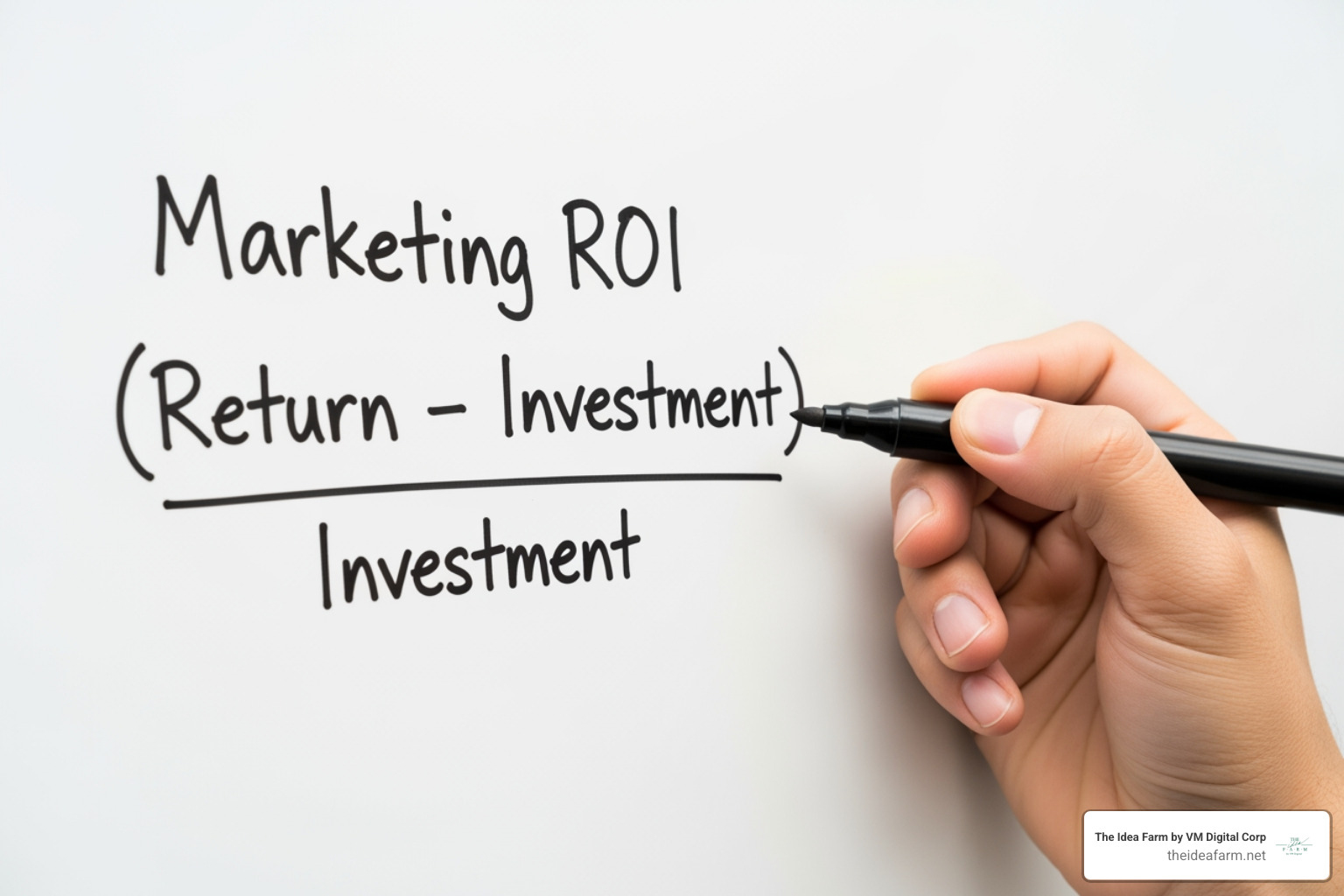
Conversion rate optimization is the systematic process of increasing the percentage of website visitors who take a desired action—be it a purchase, trial signup, or contact request. It's not about random tweaks; it's about building a measurable growth system that turns your existing traffic into tangible business results.
Quick Definition:
Many leaders have a solid product but find growth inconsistent because marketing spend doesn't predictably translate into results. The real problem isn't traffic. It's conversion.
According to a 2023 survey by Ruler Analytics, the average conversion rate is just 2.9%. This means over 97% of visitors leave without taking action, representing wasted marketing dollars and missed opportunities.
Yet businesses using CRO tools report an average ROI increase of 223%. The difference isn't luck; it's having a strategic framework that treats optimization as a continuous growth system.
At The Idea Farm, we view conversion rate optimization as the bridge between marketing activity and business growth. It's where strategy meets measurement, user experience drives revenue, and data replaces guesswork. We help you build a systematic approach to understanding what makes your customers act.
I'm Jose Escalera, CEO of The Idea Farm by VM Digital. My background taught me that effective CRO starts with commercial thinking—understanding which outcomes truly matter for growth. I've spent years helping leaders build marketing systems where every dollar and visitor counts.
This guide will show you how to approach CRO as a strategic discipline. You'll learn to measure what matters, build an optimization process, and implement proven techniques for sustainable growth. This framework will help you move from guesswork to growth.
Conversion rate optimization (CRO) is a fundamental shift in how businesses approach their online presence. It's about getting more value from the traffic you already have by increasing the percentage of visitors who take a desired action, like a purchase or demo request.
This directly impacts your bottom line by maximizing your existing audience. The key benefits include:

For leaders focused on sustainable growth, CRO is a strategic imperative. At The Idea Farm, we see it as a cornerstone because it drives:
Research shows that nearly 60% of B2B marketers find CRO the most useful metric for landing page performance, and 70% use experiment outcomes to inform other marketing decisions. For more on the broad benefits, check out this resource on the Benefits of conversion rate optimization.
To optimize, you must first measure. The basic formula is:
Conversion Rate = (Number of Conversions / Total Number of Visitors) x 100%
For example, if 200 visitors result in 30 newsletter sign-ups, your conversion rate is (30 / 200) x 100% = 15%.
Beyond this, we focus on key business metrics like Lead Goals and Net New Customers. Establishing clear Key Performance Indicators (KPIs) is crucial. At The Idea Farm, we integrate these into your personalized dashboard for a clear view of progress. To see how we track these vital metrics, explore The Growth Dashboard.
Effective conversion rate optimization isn't a collection of random tweaks; it's a disciplined, strategic framework. It begins with a customer-centric approach, obsessing over users to uncover the drivers, barriers, and hooks that influence their decisions. This mindset should be applied at every stage of your business growth.
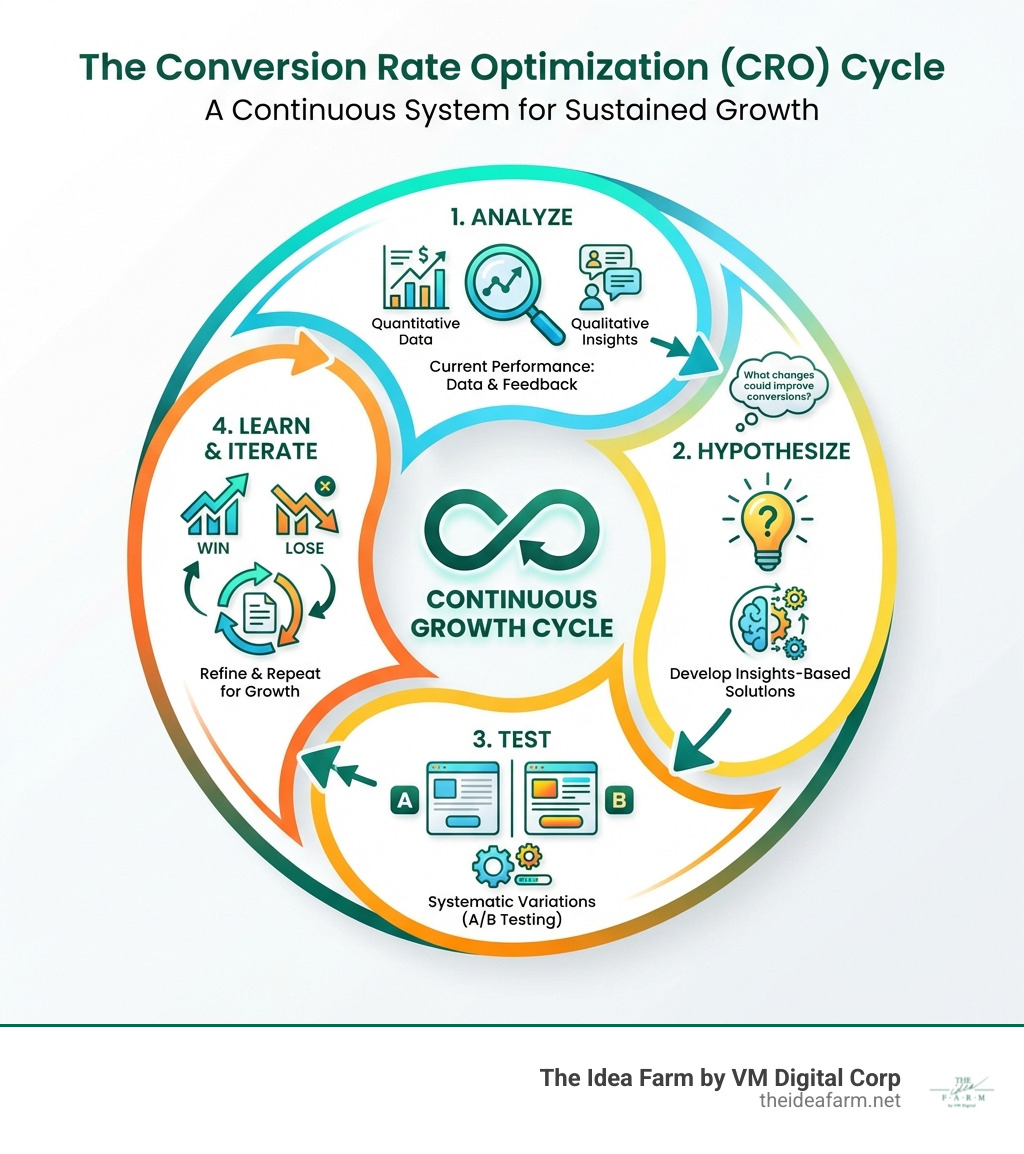
Our CRO process follows a systematic flow: Research, Hypothesis, Prioritization, Testing, and Learning. This structured approach helps gain organizational buy-in and frames CRO as an investment in predictable growth, not a speculative expense. When budgeting, we account for human capital, tools, and the opportunity cost of not optimizing.
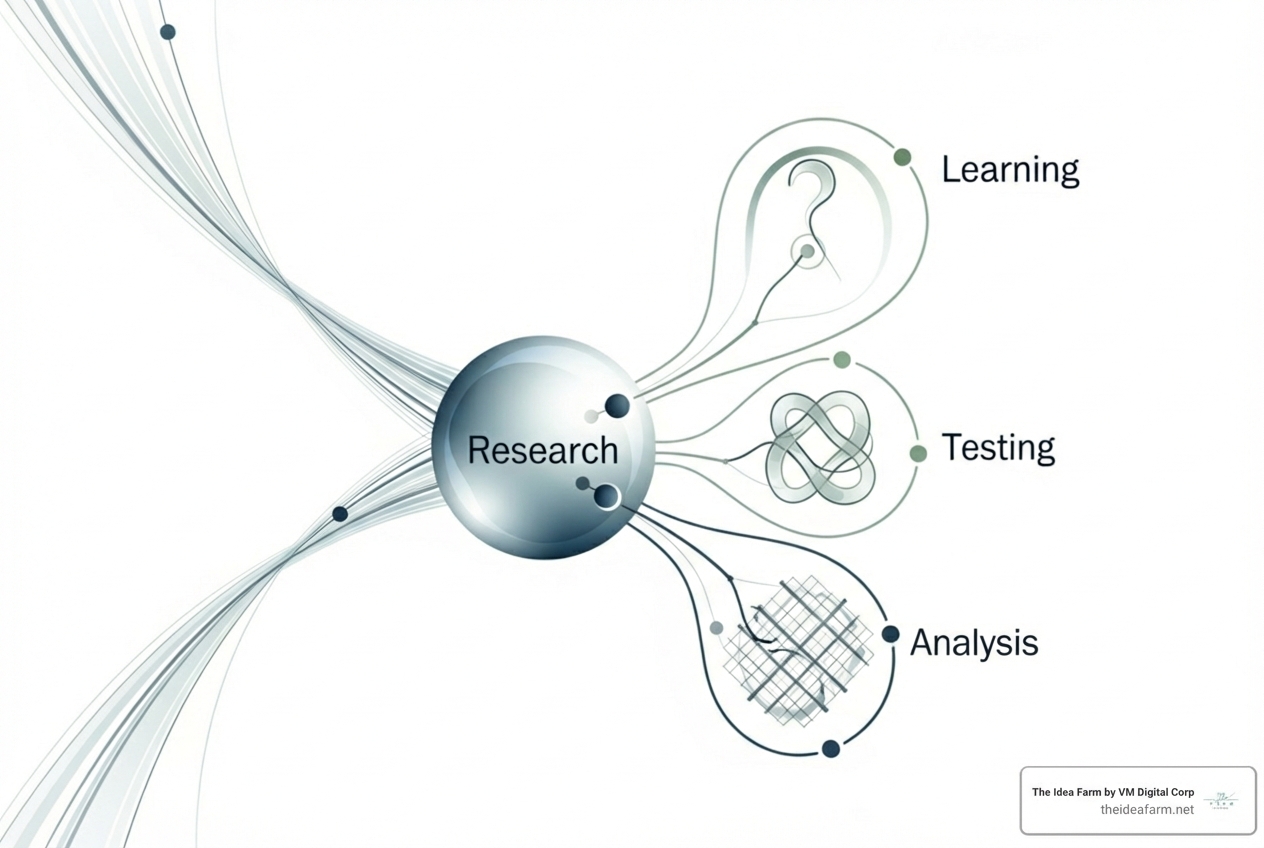
Let's explore the engine room of CRO:
Research: We gather data to understand "what's happening" and "why."
Hypothesis: Based on research, we formulate an educated guess: "IF we make change X, THEN outcome Y will occur, BECAUSE of reason Z." For example: "IF we simplify the checkout form, THEN more users will complete their purchase, BECAUSE it reduces friction."
Prioritization: Since resources are finite, we use frameworks like P.I.E. (Potential, Importance, Ease) to prioritize tests, focusing on changes with the highest potential impact.
Testing: We validate hypotheses through experimentation.
Learning & Iteration: The goal is learning, not just "winning." Many tests don't produce a direct uplift but always provide valuable insights into user behavior. We analyze all results, document findings, and share them across teams to inform future strategy. This continuous cycle of learning and iteration drives sustained growth.
While conversion rate optimization and SEO (Search Engine Optimization) have different primary goals, they are two sides of the same coin. SEO drives traffic; CRO converts it. They work together to improve user experience.
How does CRO help SEO? By improving key engagement signals:
Both CRO and SEO are about serving humans. By focusing on a great user experience through CRO, you naturally create a website that search engines favor. For more insights on attracting and converting traffic, you can explore our strategies around digital ads.
Now that we understand the strategic framework, let's get practical. This section focuses on turning insights into tangible website improvements.
Here are some go-to techniques for boosting conversions:
Certain elements are non-negotiable for a high-converting website:
For a deeper dive into creating robust online foundations, explore our insights on website systems.
To implement conversion rate optimization, we rely on a suite of powerful tools. Here's a look at some essential categories:
| Tool Type | Purpose | Examples |
|---|---|---|
| Analytics Platforms | Track website traffic, user behavior, conversion goals, and source data. | Google Analytics (especially with GA4 integration), Heap Analytics |
| Behavior Analysis Tools | Visualize user interactions, identify pain points, and understand "why." | Hotjar (heatmaps, session replays, surveys), Contentsquare |
| A/B Testing Platforms | Create and run experiments, comparing variations of pages or elements to determine winners. | VWO, Optimizely |
| User Feedback Tools | Gather qualitative insights directly from users through surveys, polls, and interviews. | Five Seconds Test, SurveyMonkey |
These tools provide the data and capabilities needed to conduct research, formulate hypotheses, run tests, and analyze results effectively.
Conversion rate optimization is not a one-size-fits-all strategy. It must be adapted to specific contexts and evolve with technology and user behavior.
While CRO principles are universal, their application varies:
The CRO landscape is constantly evolving. Here are key trends on the horizon:
CRO is both an art and a science. The science provides the data and methodology, while the art lies in understanding human psychology to craft compelling experiences.
We often hear similar questions from business leaders regarding conversion rate optimization. Let's address some of the most common ones.
This is a tricky question because "good" is relative. A 2023 survey by Ruler Analytics found that an average conversion rate across fourteen different industries was 2.9%. However, this number can be misleading. A good conversion rate depends heavily on your industry, niche, specific goals, traffic source, and audience demographics. For example, a landing page designed for a free download might have a much higher conversion rate than an e-commerce checkout page.
Our philosophy at The Idea Farm is to "stop worrying about what is ‘a good conversion rate’" in comparison to others. Instead, we focus on continuous improvement. Your "good" conversion rate is one that is consistently improving over time, helping you achieve your business objectives.
Think of it this way:
While their objectives differ, they are deeply interconnected. A website optimized for conversions (CRO) often provides a better user experience, which search engines (SEO) favor, leading to higher rankings and more traffic. Conversely, driving highly targeted traffic through SEO means a better chance of conversion through CRO. They work together to improve user experience and ultimately, business results.
The timeline for seeing results from conversion rate optimization can vary widely. Some tests might show significant uplifts in a matter of weeks, especially if they address major friction points or are run on high-traffic pages. For instance, Hotjar saw over 400 new leads in just three weeks from a simple email opt-in pop-up.
However, it's crucial to understand that CRO is an ongoing process, not a one-time project. Your audience, market, and competitors are constantly changing, meaning optimization is never truly "done." The goal isn't just to get a quick win, but to establish a continuous learning system that consistently refines your website's performance over months and years. This builds a culture of experimentation and data-driven growth.
Conversion rate optimization is more than a marketing tactic; it's a strategic discipline that empowers businesses to open up their full online potential. By systematically understanding user behavior, removing friction, and optimizing every touchpoint, you can transform your website into a powerful growth engine. We've seen how CRO lowers customer acquisition costs, boosts ROI, improves brand reputation, and provides invaluable insights into your audience.
At The Idea Farm, our philosophy aligns perfectly with the principles of CRO. We believe in building connected, data-driven marketing systems custom to your unique numbers and goals. We work with leaders in Houston, TX, and Danville, Kentucky, and beyond, to ensure consistent, scalable growth. By adopting a mindset of continuous improvement and focusing on the customer experience, you're not just optimizing your website; you're cultivating a sustainable growth culture for your entire business.
Ready to stop guessing and start growing? Let's plant the seeds of a continuous growth culture together. Partner with a Fractional CMO to build your growth engine and turn your website into a conversion powerhouse.