Why Customer Success Analytics Separates Winners From Churners

Customer success analytics is the practice of collecting, measuring, and acting on post-sale customer data to predict behavior, prevent churn, and identify growth opportunities. Here's what matters most:
- Core Metrics: Track churn rate, Net Revenue Retention (NRR), Customer Lifetime Value (CLV), and customer health scores
- Key Data Types: Product usage, customer feedback (NPS, CSAT), support tickets, and financial signals
- Primary Benefit: Shift from reactive firefighting to proactive engagement that drives predictable revenue
- Getting Started: Build explainable health scores, set up automated alerts, and match tools to your team size and budget
When a customer leaves and it catches you off guard, it's rarely because the warning signs weren't there. They were. You just didn't have the system to catch them in time.
Most B2B SaaS companies react to churn after it happens. They scramble when renewal conversations go sideways or when a power user suddenly goes quiet. But companies that master customer success analytics operate differently. They spot the dip in active users three months before renewal. They see when usage shrinks to a single department. They know which accounts are ready to expand because the data tells them.
The difference isn't luck. It's infrastructure. Companies that make intensive use of customer analytics are 2.6 times more likely to have significantly higher ROI and 3 times as likely to generate more revenue growth than their competitors. Yet less than half of SMBs say they're truly data-driven.
For business leaders tired of unpredictable growth and wasted effort, customer success analytics transforms your CS function from a cost center reacting to problems into a growth engine that prevents churn and surfaces expansion opportunities systematically.
I'm Jose Escalera, CEO of The Idea Farm, and I've spent my career building companies and revenue systems where strategy, marketing, and sales must work in lockstep—which is exactly what customer success analytics enables at scale. Before stepping into this role, I learned that sustainable growth requires more than good intentions; it demands measurable systems that turn customer signals into repeatable action.
The Foundation: Key Metrics and Data for Customer Success Analytics
In the dynamic world of B2B SaaS, guesswork is a luxury few can afford. Without clear data, customer success teams are left navigating blind, reacting to problems after they've escalated. This is where customer success analytics becomes indispensable. It provides the clarity needed to move from reactive firefighting to proactive, predictable growth. The importance of a single source of truth for customer data cannot be overstated; it’s the bedrock upon which all effective strategies are built.
Aligning your customer success metrics with executive strategy is not just good practice—it's a growth accelerator. Research shows that companies with a single growth-focused C-level leader grow up to 2.3× faster. This isn't just about having a leader; it's about having a unified vision fueled by accessible, actionable data. At The Idea Farm, we understand that for leaders in Houston, TX, or Danville, Kentucky, making data-driven decisions is paramount to scaling. The core data types we discuss here are what fuel those crucial insights.
To truly understand our customers, we must tap into various data streams. These aren't just numbers; they're the digital breadcrumbs customers leave behind, telling us about their journey, their satisfaction, and their potential.
- Product Usage Data: This is gold. It tells us how customers interact with our product. We look at:
- Feature adoption: Which features are customers using, and which are gathering dust? Are they using the core features that deliver value?
- Session duration and frequency: How long are users spending in the product, and how often do they log in? A sudden drop here can be an early warning sign. An active user percentage below 60% often suggests tough renewal conversations ahead, while above 80% indicates the product has become a core part of their day-to-day.
- Depth of engagement: Are they just logging in, or are they deeply integrating the product into their workflows across multiple departments? Tools like Amplitude and Mixpanel are excellent for tracking individual user behavior, but for customer success, we need to aggregate this at the account level to understand overall health, not just individual clicks. We need to know if a 50-user account has its main contact not logging in for 7 days—that's a risk.
- Customer Feedback Data: Directly asking customers for their opinions provides invaluable qualitative and quantitative insights.
- Net Promoter Score (NPS): How likely are customers to recommend us? This is a powerful indicator of loyalty and potential advocacy.
- Customer Satisfaction Score (CSAT): How satisfied are they with a specific interaction or the product overall?
- Customer Effort Score (CES): How easy was it for them to achieve their goal or resolve an issue? Minimizing customer effort is critical for increasing loyalty.
- We know that 88% of CX specialists say personalization is now critical to loyalty, and customer feedback is key to enabling that.
- Support Ticket Data: Our support interactions are rich sources of information about customer pain points and overall experience.
- Resolution times: Are we solving problems quickly enough?
- Ticket volume: A sudden spike could indicate a product issue or a struggling customer.
- Types of issues: Are common problems emerging that point to gaps in our product, documentation, or onboarding?
- Financial Data: Customer success impacts the bottom line.
- Renewal rates: Are customers staying with us?
- Expansion revenue: Are they growing with us through upsells and cross-sells?
- Average Revenue Per User (ARPU): Dips in ARPU can show up 3-6 months before churn, offering a crucial leading signal.
The North Star Metrics That Drive Retention and Growth
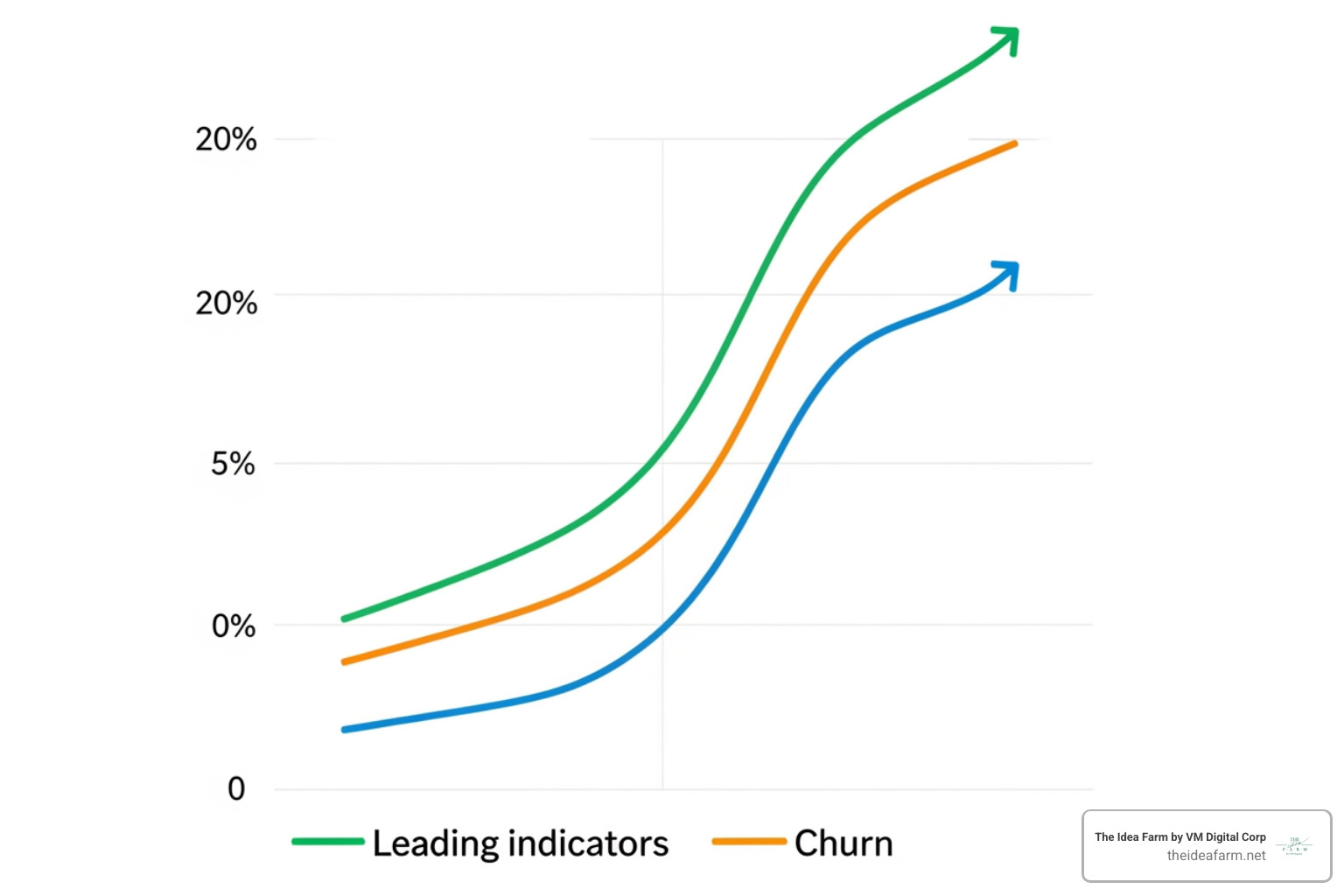
While all data is valuable, some metrics serve as our North Stars, guiding our strategies and indicating our overall health. We differentiate between leading indicators (which predict future outcomes) and lagging indicators (which tell us what has already happened). For proactive customer success, leading indicators are our best friends.
- Customer Churn Rate: This lagging indicator tells us the percentage of customers who stopped using our service over a given period. It's a critical measure, but it's often too late to act once churn has occurred. Retention norms vary by sector, but according to Shopify, most industries fall between 70–80% average retention rates. If small clients are churning, it signals that our low-touch strategies may need work or our target market needs adjustment.
- Net Revenue Retention (NRR): This is arguably the most important metric for B2B SaaS. NRR measures the revenue retained from existing customers, including upgrades, downgrades, and churn. An NRR above 100% means we're growing even without acquiring new customers, which is fantastic. ChartMogul reports that top-quartile SaaS companies, particularly those with $15–30M ARR, often achieve NRR between 115–120%, setting a benchmark for what’s possible. We believe NRR is a strong indicator of the impact our customer success efforts have on revenue retention and up-sell.
- Customer Lifetime Value (CLV): CLV estimates the total revenue we can expect from a customer over their entire relationship with us. Understanding CLV helps us prioritize which customers to invest in and how much, ensuring we're maximizing our long-term growth.
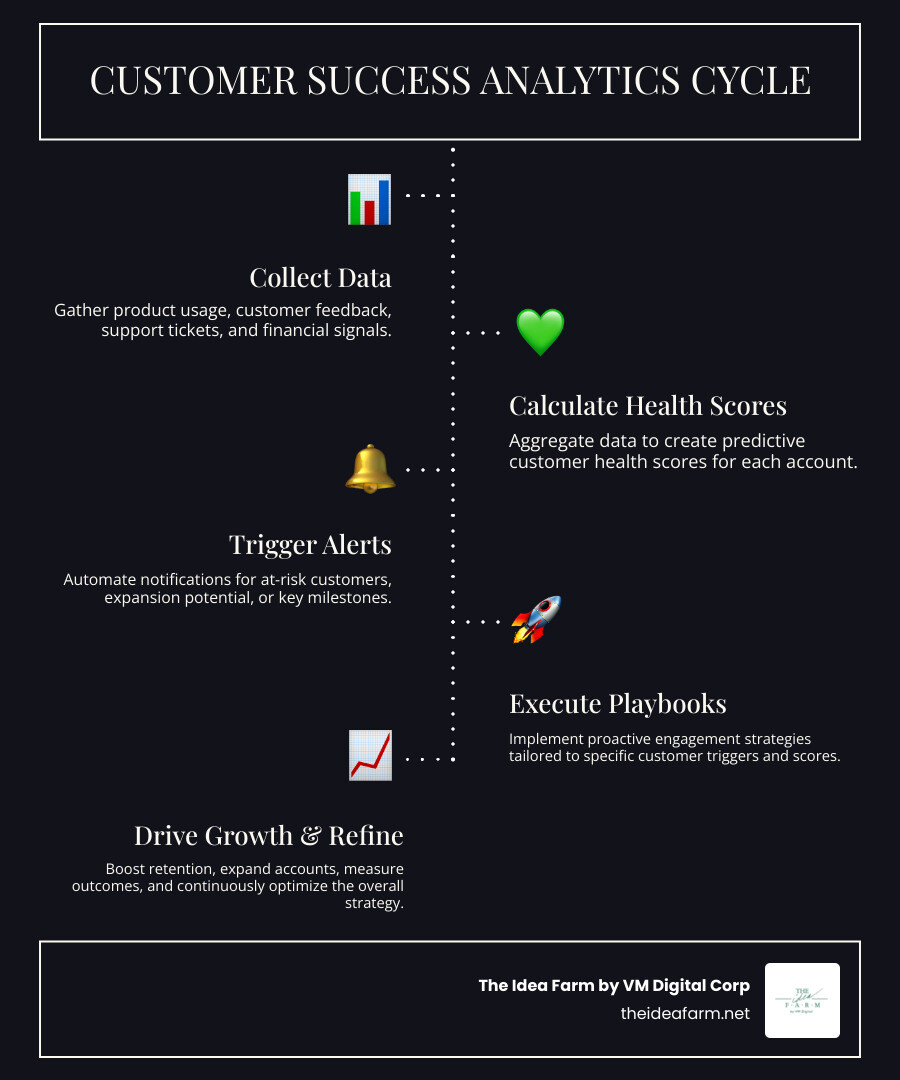
- Customer Health Score: This is our ultimate leading indicator. A customer health score blends various inputs—product usage, support history, adoption data, and even qualitative CSM feedback—into a single, composite measure of account health. It acts as an early-warning system for churn and highlights expansion opportunities, helping us predict relationship stability and identify at-risk customers. As the team at Zendesk puts it, "Ever notice how the smallest signals from your customers can predict the biggest changes in your business?" The health score is designed to capture those signals.
From Data to Action: Building Health Scores and Strategic Playbooks
We've gathered the data, identified our North Star metrics, and now comes the crucial part: turning that data into tangible action. Data without action is just noise. Our goal at The Idea Farm is to help leaders like you transform those insights into a repeatable system for your team, empowering your Customer Success Managers (CSMs) without overwhelming them. After all, building robust growth systems is what we do.
How to Build Customer Health Scores Your Team Will Actually Trust

A customer health score is only as valuable as the trust your team places in it. The problem with "black box" scores—where the calculation is opaque—is that CSMs quickly lose faith. If a health score drops from 78 to 65 without a clear explanation, your team will ignore it. Here’s how we build health scores that truly resonate:
- Start with Clean Event Tracking: This is non-negotiable. Bad data in means bad scores out. We need solid event tracking, ensuring accurate user IDs and user-to-account mapping. Tools like Segment or RudderStack are excellent for setting up proper event tracking.
- Weight Actions Based on Value, Not Volume: Not all actions are created equal. Logging in is good, but integrating a key feature is better. We score actions based on the value they bring to the customer's workflow (e.g., 1-10), not just how often they happen. Give low scores (1-2) to things like logging in or browsing, and high scores (7-10) to actions that signify deep adoption or value realization.
- Combine Multiple Data Points: A robust health score is a composite. It pulls from product usage, support interactions, survey results, and even CSM sentiment. We recommend focusing on 4-6 clear, reliable metrics that reflect engagement, value, and risk. Deloitte documents that such an investment helped a global software firm improve both customer health and overall business value scores by 15 and 25 points, respectively.
- Make Scores Explainable: This is key for trust. When a score changes, CSMs need to see why. Was it a drop in active users? A spike in support tickets? A negative NPS response? The system should clearly articulate the contributing factors. This transparency helps CSMs understand the "why" behind the numbers, enabling them to act effectively.
Creating a Customer Success Playbook for Proactive Engagement
Once we have reliable health scores, we can build playbooks—structured, repeatable responses to specific customer signals. These playbooks transform data into actionable steps, guiding CSMs to engage proactively.
- Defining Triggers: Playbooks are triggered by changes in customer health or specific events.
- Low Health Score Playbook: If a customer's health score drops below a certain threshold (e.g., "At-Risk"), a playbook might trigger an automated email, assign a task to the CSM to investigate, or prompt a check-in call.
- Expansion Opportunity Playbook: If usage is growing across multiple departments, or a customer activates a premium feature, a playbook could alert the CSM to explore upsell potential.
- Onboarding Success Playbook: During onboarding, consistent engagement with key features could trigger a "celebration" message or an offer for advanced training.
- Proactive Issue Resolution: Instead of waiting for a customer to complain, playbooks allow us to intervene. If a customer's product consumption has decreased, a playbook could suggest offering additional training or resources.
- Personalizing Outreach at Scale: With playbooks, we can deliver highly personalized engagement. We know that 88% of CX specialists say personalization is now critical to loyalty. Playbooks allow us to tailor messages and actions based on specific customer segments, their stage in the journey, and their unique signals. Gartner research indicates that B2B buyers are 1.8x more likely to say "yes" to a deal when they have access to supplier-provided digital tools alongside sales rep collaboration, underscoring the power of custom digital engagement.
The Growth Engine: Choosing and Using Your Analytics Stack
Selecting the right tools for your customer success analytics stack is a critical decision that significantly impacts your team's efficiency and your company's growth trajectory. The right tool depends heavily on your team's stage and maturity. For many early-stage companies, falling into the "enterprise trap" of over-investing in complex, expensive platforms can be a major pitfall. Our goal isn't just to gather data, but to get actionable insights directly into the tools your team already uses, like Slack or your CRM.
The customer success analytics landscape is diverse, offering solutions for every company size and budget. Understanding the differences is crucial to making an informed decision.
| Tool Category | Primary Focus | Target Team Size | Typical Annual Cost | Implementation Time | Technical Resources Needed |
|---|
| Product Analytics | Individual user behavior, product development | Any | Varies | Days to Weeks | Product/Data Teams |
| Lightweight CS Intelligence | Account health signals, proactive CS actions | 2-10 CSMs | $50/month - $2,000/month | Hours to Days | Minimal |
| Enterprise CS Platforms | Comprehensive CS automation, large-scale ops | 20+ CSMs, mature teams | $30,000 - $80,000+ | Months | Dedicated Ops Team |
Let's break these down:
- Product Analytics Tools (e.g., Amplitude, Mixpanel): These are fantastic for understanding how individual users interact with your product. They excel at showing which features are getting used. However, they are built for product teams, not customer success. They don't inherently help you spot which accounts are likely to churn or grow, which is critical for B2B relationships.
- Enterprise CS Platforms (e.g., Gainsight, ChurnZero, Totango): These big-name tools sound great on paper, offering comprehensive features like robust automation, health scoring, and sophisticated reporting. However, they are built for large, mature teams (typically 20+ CSMs) with dedicated operations staff. Their annual contracts usually fall between $30,000 and $80,000+, and implementation can take months. Most early-stage companies struggle to get full value from them due to the cost, complexity, and resource requirements.
- Lightweight CS Intelligence Tools: This is the "missing middle" that many early-stage B2B SaaS companies need. These tools focus on delivering quick, clear signals about account health without the overwhelming complexity or price tag of enterprise solutions. They can start at roughly $50/month for growth plans and remain well below $2,000/month even for larger self-serve teams. Setup is incredibly fast; some, like Accoil (mentioned in our research), can help you start seeing data flow within 8 to 24 hours. These tools are ideal for lean CS teams (2-5 CSMs) looking for speed and actionable insights.
When choosing, consider your current team size (are you a small team in Houston, TX, or a scaling one in Danville, Kentucky?), your budget, and the technical resources you have available. Don't overbuy; start with what you need to get clear, actionable signals.
The Power of Automated Alerts and Role-Based Dashboards
One of the most transformative aspects of customer success analytics is the ability to move beyond manual dashboard checking. We want our CSMs to spend their time building relationships and solving problems, not digging through data.
- Automated Alerts: Imagine starting your day with a clear, concise alert in Slack (or your CRM like HubSpot or Salesforce) telling you exactly which customer needs your attention and why. This shift makes your team faster, sharper, and more effective. Alerts can flag:
- A 50-user account where the main contact hasn't logged in for 7 days, indicating potential risk.
- An account where usage is growing across multiple departments, signaling an expansion opportunity.
- A power user deactivating their account, signaling risk for the entire account.
- These alerts push context right to the CSM, allowing them to act immediately.
- Role-Based Dashboards: Not everyone needs to see the same data.
- Executive Dashboards: For leaders, dashboards should focus on high-level trends like overall NRR, churn rate, and renewal pipeline broken down by at-risk revenue. This helps align strategic decisions. We can help you build a robust growth dashboard that provides these critical insights.
- CSM Dashboards: For CSMs, dashboards should focus on accounts that need immediate attention, with clear reasons for risk or opportunity, enabling them to prioritize their daily tasks effectively.
- This targeted approach ensures that everyone has the information they need, in the format they need it, to drive our collective goals.
Overcoming Common Problems in Implementation
Even with the best intentions and tools, implementing customer success analytics isn't always smooth sailing. We've seen many analytics initiatives falter, not due to a lack of data, but due to common pitfalls that can be easily avoided with the right strategy.
- Data Silos and Inconsistent Data: This is perhaps the biggest hurdle. When customer data is scattered across different systems (CRM, product database, support tickets, billing), it's impossible to get a unified view. Overworked data teams often spend most of their time fixing broken pipelines and cleaning data, rather than generating insights.
- Solution: Prioritize integrating your data sources. Tools like Segment or RudderStack can help consolidate event tracking. For comprehensive data harmonization, platforms like Salesforce's Data 360 can unify information from various sources like internal data lakes, warehouses, and business applications.
- Lack of Team Buy-in: If the CS team doesn't understand or trust the analytics, they won't use them. A "black box" health score, for example, will be ignored.
- Solution: Involve your CS team in the building process. Explain how health scores are calculated and why certain metrics are chosen. Make the scores explainable, showing the underlying reasons for changes. Their input is invaluable for creating a system they'll actually use.
- Over-engineering Solutions: Especially for early-stage companies, trying to implement an enterprise-level system from day one can lead to wasted resources and frustration.
- Solution: Start small with clear wins. Focus on a few critical metrics and automated alerts that deliver immediate value. You don't need a Rolls-Royce when a reliable sedan will get you where you need to go faster and more efficiently. Lightweight CS intelligence tools are perfect for this.
- Alert Fatigue: If CSMs are bombarded with too many alerts, or alerts that aren't truly actionable, they'll start ignoring them.
- Solution: Be selective. Start with clear, high-impact patterns that matter (e.g., a critical health score drop or a major expansion signal). Refine your alert thresholds over time based on feedback from your team. The goal is quality over quantity.
By proactively addressing these challenges, we can build a robust and effective customer success analytics system that truly empowers our teams and drives predictable growth.
Frequently Asked Questions about Customer Success Analytics
We often encounter similar questions from leaders looking to leverage customer success analytics. Here are some of the most common ones we address:
What is the primary benefit of customer success analytics for a B2B SaaS company?
The primary benefit is a fundamental shift from a reactive to a proactive approach to customer retention and expansion. Instead of being surprised by churn, customer success analytics allows you to identify churn risks months in advance. Similarly, it highlights growth opportunities within your existing customer base, leading to more predictable revenue and sustainable growth. We can systematically nurture customer relationships, understand their needs, and intervene precisely when it matters most, maximizing their lifetime value. This proactive stance is a game-changer for businesses in competitive markets like Houston, TX, and Danville, Kentucky.
How is customer success analytics different from product analytics?
While both are vital, they serve different masters. Product analytics (often powered by tools like Amplitude or Mixpanel) focuses on individual user behavior within the product. It helps product teams understand feature adoption, user flows, and engagement patterns to inform product development.
Customer success analytics, on the other hand, aggregates data at the account level to understand overall customer health, renewal likelihood, and expansion potential. It’s built for customer success teams to answer questions like, "Which accounts are at risk?" or "Which accounts are ready for an upsell?" It considers a broader spectrum of data, including support interactions, feedback, and financial signals, to provide a holistic view crucial for B2B relationships where the account, not just the individual user, is the primary unit of success.
Can a small team implement customer success analytics effectively?
Absolutely! In fact, small teams often have an advantage due to their agility. The key is to start smart and not overcomplicate things. Small teams can be highly effective by:
- Starting with lightweight, affordable tools: As discussed, enterprise platforms are often overkill. Many effective, affordable solutions exist that integrate with your existing data sources.
- Focusing on a few critical metrics: Don't try to track everything at once. Identify 2-3 key metrics (like active usage percentage, key feature adoption, or a simple health score) that are most predictive for your business.
- Setting up simple, automated alerts: This is crucial. Instead of manually checking dashboards, have the system tell your CSMs when an account needs attention. This minimizes manual effort and maximizes impact.
- Building explainable health scores: Ensure your team trusts the data.
By focusing on clarity, actionability, and efficiency, even a lean team can implement powerful customer success analytics that drive significant results.
Conclusion: Cultivating Predictable Growth
Mastering customer success analytics isn't about drowning in data; it's about cultivating the right information to grow customer relationships and revenue predictably. It transforms our approach from reactive guesswork to strategic, data-driven action, allowing us to anticipate customer needs, prevent churn, and open up expansion opportunities. This capability is no longer a luxury but a core component of a modern, data-driven marketing and growth system.
At The Idea Farm, we believe that leaders deserve marketing and growth solutions that are as focused on results as they are. We help businesses in Houston, TX, and Danville, Kentucky, build these connected, data-driven systems, tailoring them to your unique numbers and goals. We turn raw customer signals into actionable insights, ensuring consistent, scalable growth. It's about turning data into delight—for both your customers and your bottom line.
Ready to transform your customer success into a predictable growth engine? Learn how a Fractional CMO can build your growth system.