
February 18, 2026

B2B marketing growth doesn't come from executing random campaigns or chasing the latest channel. It comes from building a system—a deliberate, integrated approach that turns marketing from a cost center into a predictable growth engine.
If you're here looking for quick wins, here's what actually drives sustainable B2B growth:
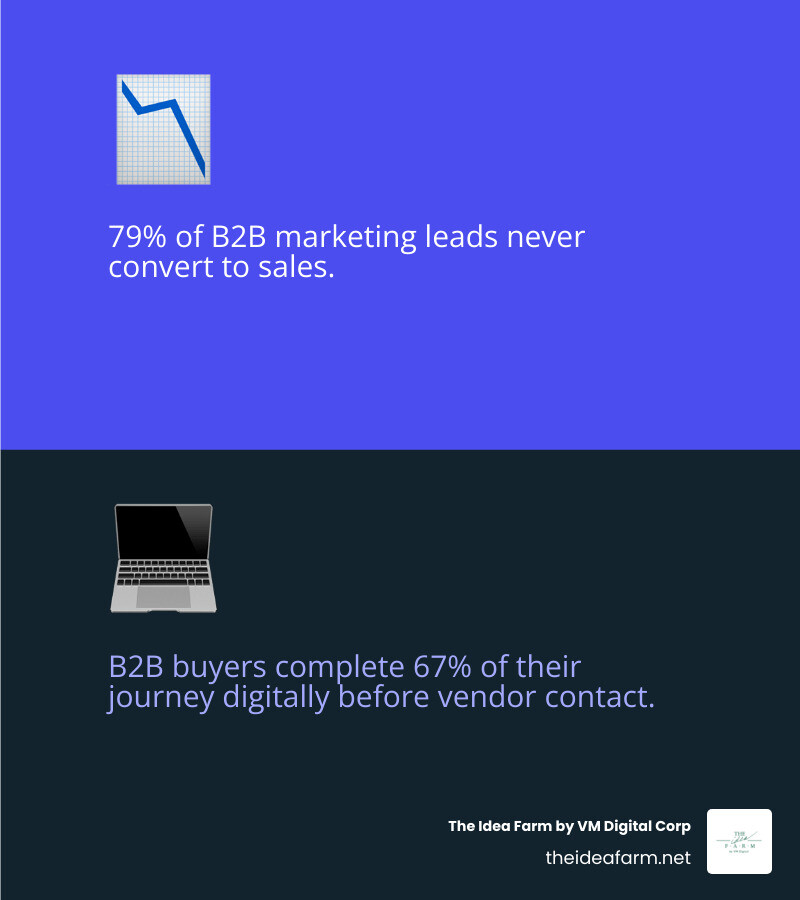
The reality: Most B2B companies are stuck executing disconnected tactics—running ads without content support, creating content without distribution, attempting outbound without proper targeting. According to recent research, 79% of marketing leads never convert to sales, and the culprit is almost always poor lead nurturing and misaligned systems.
The traditional B2B playbook is broken. The linear funnel doesn't reflect how buying committees actually make decisions. The "spray and pray" approach wastes budget on poor-fit prospects. And the disconnect between marketing and sales creates friction that kills pipeline velocity.
What changed? B2B marketing has evolved from a support function into a strategic growth driver. Marketing now influences everything from brand positioning to customer experience to competitive differentiation. Data and AI have unified previously siloed disciplines—breaking down walls between brand, demand gen, content, and product marketing. Today's B2B buyers conduct 67% of their journey digitally, often reaching 70% completion before ever contacting a vendor.
This shift demands a new approach: integrated systems over isolated campaigns. Companies that grow consistently don't just execute better tactics—they cultivate a marketing ecosystem where channels reinforce each other, data flows freely, and every action connects to revenue.
Think of it like farming. You don't just plant seeds and hope for the best. You prepare the soil (positioning and messaging). You plant strategically (targeted content and outreach). You nurture growth (lead management and alignment). And you harvest at the right time (sales readiness and conversion). The Idea Farm exists to help leaders build exactly this kind of system—one that produces predictable, scalable B2B marketing growth.
I'm Jose Escalera, CEO of The Idea Farm by VM Digital, and I've spent my career helping companies move from founder-led chaos to systematic, measurable B2B marketing growth. My background in company building, media production, and sales taught me that effective marketing isn't about creativity alone—it's about building commercial systems that create demand, support sales, and deliver accountable outcomes.
The world of B2B marketing has undergone a seismic shift. No longer a mere support function, marketing has become a strategic growth driver, fundamentally reshaping how businesses connect with their customers. We've moved from a traditional, product-centric approach to a data-driven, AI-powered, customer-first model. This evolution means marketing now influences everything from brand perception and pipeline generation to customer experience, product positioning, and competitive differentiation. It's about building a connected marketing system that aligns with your numbers and goals.
Understanding the fundamental differences between B2B and B2C marketing isn't just academic; it's crucial for crafting effective growth strategies. Here's how they stack up:
| Feature | B2B Marketing | B2C Marketing |
|---|---|---|
| Audience | "Buying committee" of multiple stakeholders | Single individual |
| Sales Cycle | Long and complex (weeks, months, years) | Short (minutes, hours) |
| Motivation | Logic, data, ROI, business value, justification | Emotion, brand status, personal desire |
| Content Focus | Educational, in-depth (whitepapers, case studies) | Entertaining, aspirational, immediate awareness |
In B2B, you're not selling to one person, but to a "buying committee" of multiple stakeholders, each with different roles and priorities. This necessitates rational decision-making, where buyers need to justify their purchase based on business value and potential ROI. The sales cycles are inherently long and complex, demanding a focus on building relationships and trust over time. Our website systems are designed to support these complex journeys, providing the infrastructure for detailed content and consistent engagement. More info about our website systems.
Data and AI are not just buzzwords; they are the unifying forces changing B2B marketing. Traditionally, marketing disciplines like brand, demand generation, digital, content, and product marketing often operated in silos. Today, data drives all facets of marketing, breaking down these walls and ensuring alignment across functions.
AI's role, in particular, is evolving beyond individual productivity and content development. It's moving towards real-time decision-making, optimization, and predictive insights. For us, this means leveraging AI to anticipate market trends, understand customer needs, and personalize experiences at scale. Generic messaging no longer cuts it; using first-party data and AI, we can deliver highly personalized experiences across the entire customer journey, from initial touchpoint to post-purchase support. This shift helps our clients move from simply generating leads to strategically influencing revenue through deeper analytics and attribution models.
A robust B2B marketing growth strategy isn’t just a collection of tactics; it’s a foundational framework built on several interconnected pillars. At The Idea Farm, we believe in building a system, not just throwing spaghetti at the wall. These pillars ensure every marketing effort contributes to a cohesive, measurable growth engine.

Before you can grow, you must know who you're growing for. Defining your Ideal Customer Profile (ICP) is about identifying the types of companies that derive the most value from your solutions. This goes beyond basic firmographics to include technology infrastructure compatibility, budget cycles, and organizational change readiness. Once we have our ICP, we outline detailed buyer personas, which capture the roles, pain points, goals, and information consumption habits of the individuals within that buying committee. You're selling to a committee, so understanding each member's perspective is vital for effective market segmentation and data analysis.
Your value proposition is the core promise you make to your customers. In B2B, this must be crystal clear, addressing specific business problems, demonstrating quantifiable impact, and showcasing clear differentiation from competitors. B2B buyers are driven by logic and potential ROI; they need to justify their purchase based on tangible business value. We help our clients articulate their unique value, translating features into benefits that resonate with the rational, data-driven mindset of a buying committee.
Content remains the central engine of B2B acquisition and deal acceleration. However, it's not just about producing content; it's about building a data-driven content marketing engine where content acts like a product line. B2B content is educational and in-depth, utilizing formats like whitepapers, case studies, and webinars to build authority and trust. This content isn't just for inbound attraction; it also serves as crucial "air cover" for outbound efforts, providing credibility when prospects research your company. By mapping content to buyer personas and stages of the journey, we ensure every piece serves a strategic purpose. For insights on how AI can support content creation, check out this article on supporting outbound efforts with valuable content.
In the B2B world, search remains a primary findy and validation channel, especially for high-consideration solutions. Foundational SEO is one of the highest-efficiency demand-generation levers when executed against buyer-intent patterns rather than vanity keywords. Our approach focuses on technical SEO, ensuring your site is crawlable and fast, alongside robust on-page optimization that aligns with what your target audience is actively searching for. Building authority through quality backlinks and thought leadership content ensures long-term yield, positioning your brand as a trusted resource.
A powerful B2B marketing growth strategy requires a connected tech stack. This isn't just about having CRM, marketing automation, and analytics platforms; it's about ensuring these tools work together seamlessly to provide a unified view of your customer data. Sales technology, when integrated correctly, becomes a force multiplier, not an anchor. We help businesses in places like Houston, TX, and Danville, KY, implement and integrate CRMs, marketing automation, and sales engagement tools. This allows for personalized email campaigns, real-time ad spend optimization, and the ability to track every touchpoint, turning data into actionable insights for continuous B2B marketing growth. Learn how our digital ads services can integrate into your tech stack for maximum impact: More info about our digital ads services.
Traditional B2B marketing approaches often fail because they’re too siloed. Running ads without content support, creating content without distribution, or attempting outbound without proper targeting leads to wasted budgets and missed opportunities. This is why we champion the "all-bound" system—an integrated approach that combines inbound, outbound, and content marketing into a cohesive growth engine. Today, it takes significantly more touchpoints—often 30-50—to start a sales conversation than in the past. The power of all-bound marketing comes from this integration; when channels work together, they create compounding effects, generating synergy that drives predictable B2B marketing growth.

Inbound marketing is about attracting prospects who are actively looking for solutions to their problems. This includes strategies like content marketing (blogs, whitepapers, case studies), SEO, and organic social media. By creating valuable lead magnets and gated content, we draw in individuals who are already problem-aware and solution-aware. Social platforms, especially LinkedIn, play a strategic role in credibility building and category education, serving as a primary distribution layer for B2B trust and amplification.
Outbound marketing used to be limited by poor data quality and manual prospecting. However, with AI-powered tools, we can now transform outbound into a highly efficient and scalable channel. AI helps overcome these limitations through data enrichment, building comprehensive prospect profiles, and AI qualification, analyzing prospects to determine their fit. This leads to more efficient and targeted outreach, reducing the number of leads from, say, 800 to 80 highly qualified ones, at a fraction of the cost per lead. Tools like LinkedIn Sales Navigator become invaluable for B2B prospecting, while strategic cold calling and account-based outreach ensure proactive engagement with high-value targets.
Content doesn't just attract; it supports. Outbound marketing, for example, doesn’t exist in isolation within an all-bound strategy. It requires "air cover" from content marketing to be truly effective. When a prospect receives an outbound message, their first instinct is often to research the sender. High-quality, educational content builds credibility, nurtures leads, and educates the market, establishing your brand as a thought leader. This is crucial for accelerating deals and building trust over the long B2B buying cycle. To dive deeper into the principles of growth in B2B marketing, explore this resource from The 5 Principles Of Growth In B2B Marketing.
For businesses aiming for significant B2B marketing growth, especially those targeting high-value accounts, advanced strategies like Account-Based Marketing (ABM) and Sales & Marketing Alignment (Smarketing) are non-negotiable. These approaches shift the focus from individual leads to entire accounts and integrate sales and marketing into a single, cohesive revenue engine, drastically reducing friction and improving conversion rates.
Account-Based Marketing (ABM) is a focused B2B strategy where marketing and sales teams collaborate to target a specific set of high-value accounts. Rather than casting a wide net, ABM treats each target account as a "market of one," allowing for highly personalized campaigns. This means identifying target account lists, conducting deep research into their specific needs and challenges, creating custom content, and executing coordinated multi-channel outreach. For companies with long sales cycles and multiple stakeholders, like many in Houston, TX, and Danville, KY, ABM ensures that marketing resources are concentrated on the accounts most likely to generate significant revenue.
"Smarketing" is the process of integrating your sales and marketing teams to create a single, cohesive revenue engine. In B2B, where sales cycles are long and complex, this alignment is critical. It involves establishing shared goals and Service Level Agreements (SLAs) that define lead quality and follow-up times. A unified data platform provides a single source of truth, allowing both teams to track progress and understand buyer behavior. Regular communication channels and a clear lead handoff process reduce friction and ensure that leads are nurtured and converted efficiently. When sales and marketing are truly aligned, they amplify each other's efforts, leading to more predictable pipeline and revenue.
A robust B2B marketing growth strategy is incomplete without a clear plan for measuring its success. Proving ROI is essential for securing budget, demonstrating marketing's contribution to the bottom line, and holding leadership accountable. At The Idea Farm, we help leaders build a "Growth Dashboard" that provides clear, actionable insights, enabling data-driven decisions that fuel sustainable expansion.
To truly understand your B2B marketing growth, we need to track metrics that go beyond vanity. Here are the essentials:
These KPIs provide a holistic view of performance, allowing us to attribute marketing efforts directly to revenue impact. Find how our "Growth Dashboard" can bring clarity to your marketing performance: More info about The Growth Dashboard.
The journey to sustainable B2B marketing growth is one of continuous improvement. This is where A/B testing and data analysis become indispensable. By rigorously testing different variables in your campaigns—from email subject lines and ad creatives to landing page layouts and call-to-actions—we can identify what resonates most with your target audience. Data analysis allows us to understand why certain elements perform better, providing insights that inform future strategies. Marketers and sellers must consistently tweak their approach, learning from every interaction to optimize campaigns for better growth and efficiency.
The B2B landscape is dynamic, and staying ahead of emerging trends is key to future growth. Here's what we're seeing:
For leaders, these trends translate into key accountabilities for driving growth:
Achieving sustainable B2B marketing growth isn't about isolated tactics or chasing the latest shiny object. It's about building a robust, interconnected system where every component works in harmony to attract, engage, and convert your ideal customers. This systemic approach, grounded in data, powered by AI, and driven by strategic alignment, is the bedrock of predictable revenue.
At The Idea Farm, we specialize in helping leaders move beyond the chaos of disconnected marketing to cultivate this kind of growth. We act as your fractional growth partner, bringing strategic vision and hands-on execution to plan, build, and scale repeatable marketing systems custom to your specific goals. If you're ready to transform your marketing into a predictable growth engine, let's connect. Learn how a Fractional CMO can build your growth system.