
July 14, 2026
Creative digital marketing is the practice of combining original ideas, storytelling, and technology to make campaigns that people actually stop and engage with, instead of scrolling past.
Here is a quick breakdown of what it means and why it works:
Most business owners are not losing because their product is weak. They are losing because their marketing looks exactly like everyone else's.
The attention economy is brutal. Rising ad costs, banner blindness, and saturated social feeds mean that bland is expensive. When your creative does not stop the scroll, you are paying for impressions that do nothing.
One signal that captures this well: campaigns on Meta and TikTok that pair strong creative with performance strategy have achieved up to 436% revenue growth year-over-year. The creative is not decoration. It is the engine.
I'm Jose Escalera, CEO of The Idea Farm by VM Digital, and my background spans early-stage company building, media production, and sales strategy, all of which directly shape how I think about creative digital marketing as a commercial system, not just a branding exercise. That intersection of storytelling, audience psychology, and measurable outcomes is exactly what this guide is built on.
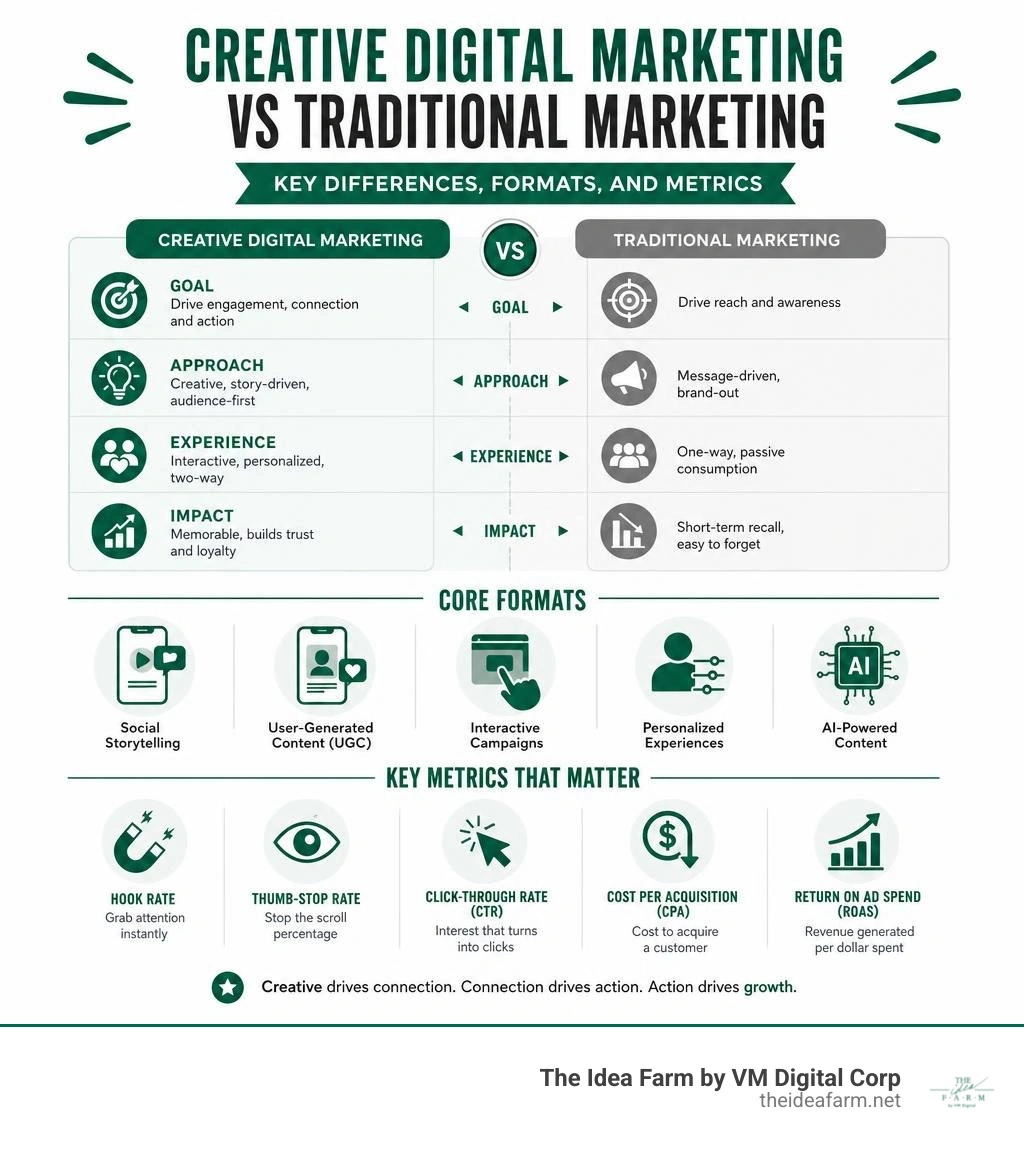
Creative digital marketing terminology:
Traditional digital marketing is about visibility. It ensures your brand shows up in search results and social feeds. Creative digital marketing is about memorability. It ensures your brand stays in the customer's mind.
In July 2026, the online space is more crowded than ever. If your business looks and sounds like every competitor, customers have no reason to choose you. Creative marketing is the spark that makes your business stand out. It turns a cold transaction into an emotional connection.
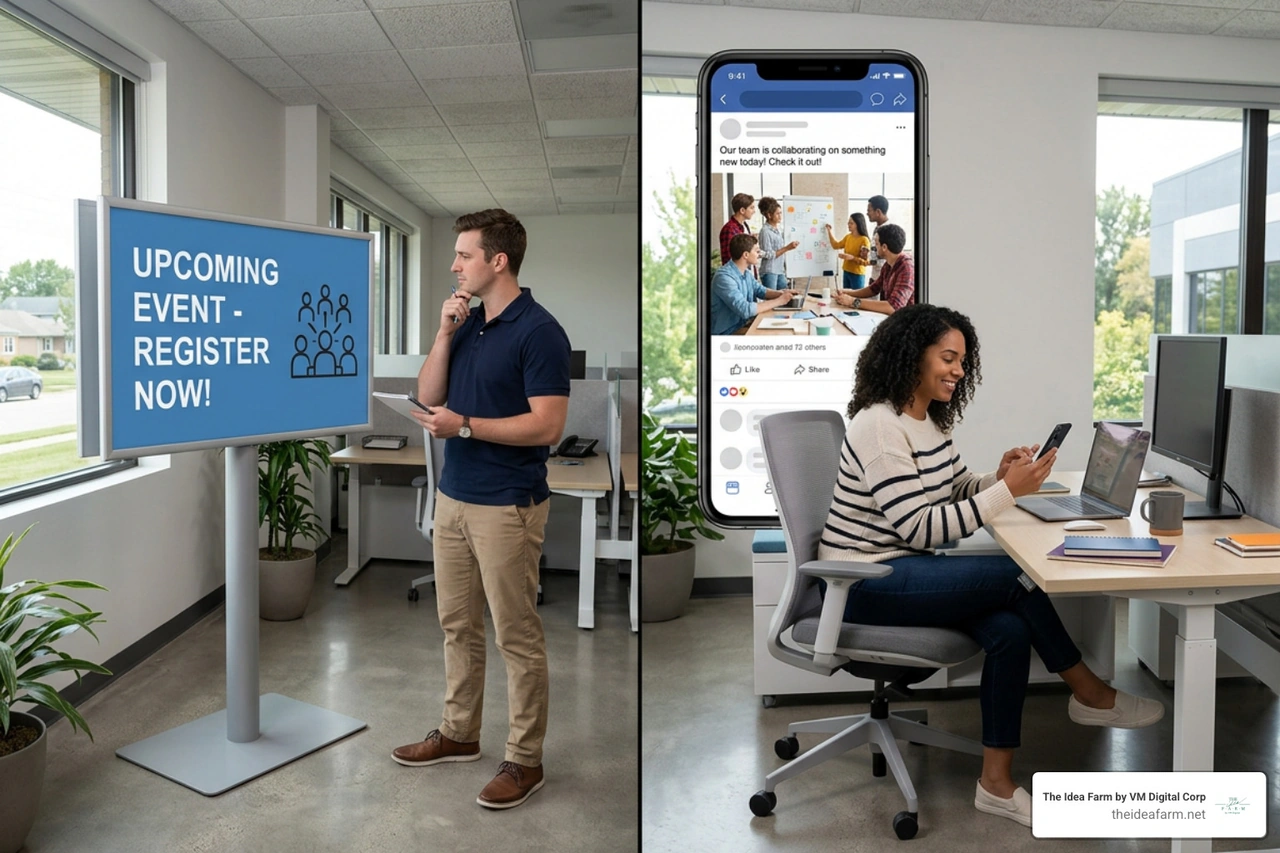
When you build a creative campaign, you do not just bid on keywords. You build a story. For example, instead of listing the specs of a product, you show how it solves a specific human problem. This approach builds deep customer loyalty. It also makes your ad dollars go much further.
To learn how to structure your overall marketing, read our Digital Marketing Service Guide 2026.
To build a system that works, you must understand the five pillars of creative marketing:
Traditional ads are dying a slow death. Customers have learned to ignore them. This is called banner blindness. Many users also install ad blockers to keep generic ads off their screens.
When social feeds are saturated, a basic sales pitch gets skipped in less than a second. Customers now expect brands to be authentic and helpful. If your ad looks like a standard billboard, it will fail. You cannot buy attention anymore. You have to earn it.
Many business owners think they have to choose between beautiful creative work and hard sales numbers. This is a false choice. In fact, the best creative work is built to drive performance.

Today, ad platforms use advanced AI systems to find your customers. Because of this, detailed audience targeting is no longer the main driver of success. Creative is now your primary targeting tool. The visuals and words in your ad tell the algorithm exactly who should see it.
To make this work, your creative assets must connect directly to your business goals. You must track how each asset impacts your bottom line. Read more about this in our guide on Marketing Performance Optimization.
To balance art and science, you must track specific creative metrics:
You should never guess which creative will perform best. Instead, use a systematic testing framework.
First, create one simple video asset. Next, write three different hooks for the first three seconds. Run a small test to see which hook gets the highest thumb-stop rate. Once you find the winning hook, test different angles in the body of the video. Finally, pour your main budget into the winning combination.

This rapid iteration keeps your costs low. It also ensures you only scale ads that are proven to convert. For a complete guide on how to run these tests, consult our Marketing Experimentation Framework Advisor.
AI has changed how we produce creative assets. In the past, creating ten different video variations took weeks. Today, AI-powered tools can reduce production time by 85% while increasing your total output.
Tools like Mako, Your AI ad creative OS. Research, create, publish. help brands research customer signals, write scripts, and render assets quickly. This allows you to test more variations without burning out your team.
A great example of rapid, creative AI usage comes from a major fast-food campaign. When KFC Arabia faced a sudden shortage of their fan-favorite cheddar sauce, they did not ignore the customer complaints. Instead, they used AI to turn the crisis into a three-episode social media drama.
They turned their own menu items into animated characters searching for the missing sauce. This playful response allowed fans to debate, write character arcs, and make memes.
The campaign was a massive success. It generated over 4 million views, 85,000 likes, and 130,000 shares organically. Best of all, it required zero paid ad spend. To read the full story, check out KFC Arabia Turns a Cheddar Sauce Crisis Into a Viral AI Drama.
While AI is a powerful tool, it cannot replace human intelligence. If you rely solely on AI, your content will start to look generic.
Dorothée Gardon, a global marketing director at IKEA, discussed this balance at Cannes Lions. She explained that great creative work must always start with the human brain and the core brand DNA. IKEA uses AI for personalization at scale, but their most viral moments still come from simple, human ideas.
For example, their viral "Punch the monkey" campaign was filmed by a social media team member using just an iPhone behind an office parking lot. It was simple, authentic, and highly successful. You can read more about her insights at IKEA’s Dorothée Gardon on AI and brand control.
To win in 2026, you must bridge the gap between your creative team and your media buying team. When these two groups work in silos, your ad budget dies in the middle.
Your media buyers must share real-time performance data with your creators. Your creators must then use that data to build the next batch of assets. Working with a unified Digital Marketing Ad Agency can help keep these teams aligned.
If you want to build this engine yourself, you can look at specialized partners like Creative Studio for Paid Social Ads | Donutz Digital . They focus on producing volume and variety specifically optimized for paid social channels.
You do not need a massive agency budget to run successful creative campaigns. If you operate a local business in Houston, TX, or Danville, Kentucky, you can win with authenticity.
Customers today prefer raw, honest content over highly polished commercial videos. Here is how to get started on a budget:
We use data to set the boundaries, and creativity to play within them. Data tells us who our audience is, what problems they have, and which ads are performing well. Creativity is how we package the solution in a way that feels fresh and exciting. The two forces must work together in a continuous feedback loop.
Yes. Some of the most successful social media campaigns are shot on basic smartphones with zero production budget. Authenticity and humor outperform expensive camera gear every single day. Focus on sharing real human moments and solving real customer problems.
While ROAS is the ultimate goal, the most important diagnostic metric is the hook rate (or thumb-stop rate). If you cannot get people to stop scrolling in the first three seconds, the rest of your video does not matter. Fix your hook first, then optimize the rest of your funnel.
At The Idea Farm, we do not believe in creative work for the sake of art. We believe in creative work that builds sustainable business growth. As a Fractional Growth Partner with offices in Houston, TX, and Danville, Kentucky, we build connected, data-driven marketing systems designed to scale your business.
We help you stop guessing and start testing. By combining deep customer insights with rapid creative execution, we make sure your marketing dollars work harder for you.
If you are ready to stop wasting budget on bland ads and start building campaigns that drive real revenue, let's talk. Scale your business with strategic digital ads.