Why PPC Campaign Management is the Difference Between Activity and Growth

PPC campaign management is the systematic process of building, monitoring, and optimizing pay-per-click advertising campaigns to drive measurable business results—not just traffic.
Quick Answer for Business Leaders:
- Strategy First: PPC management starts with clear objectives tied to revenue, not just clicks
- Core Components: Keyword research, ad creation, landing page optimization, bid management, and performance tracking
- Continuous Process: Successful campaigns require ongoing testing, analysis, and refinement
- ROI Focus: Every dollar spent should be accountable to business outcomes
- Professional Edge: Expert management saves time, avoids costly mistakes, and scales growth faster
Most businesses approach PPC as a tactic. They set up a campaign, turn on ads, and hope for the best. The result? Wasted spend, inconsistent leads, and frustration.
PPC isn't a set-it-and-forget-it lever. It's a growth system that requires architecture, cultivation, and continuous management.
The difference between clicks and conversions comes down to how you manage the entire ecosystem—from the keywords you target to the landing page experience you deliver. According to industry data, close variant conversions can cost 88% more when not properly managed. That's money left on the table.
Too many leaders find themselves buried in platform dashboards, guessing at what's working, or relying on agencies that optimize for vanity metrics instead of business growth. The truth is simpler: effective PPC management is about building a system where every element—strategy, execution, measurement, and optimization—works together toward one goal: profitable customer acquisition.
I'm Jose Escalera, CEO of The Idea Farm by VM Digital, where we help business leaders transform scattered marketing efforts into measurable growth systems, including strategic PPC campaign management that connects ad spend directly to revenue. My background in sales and company building taught me early that marketing must serve a commercial purpose—it's not about impressions, it's about outcomes.
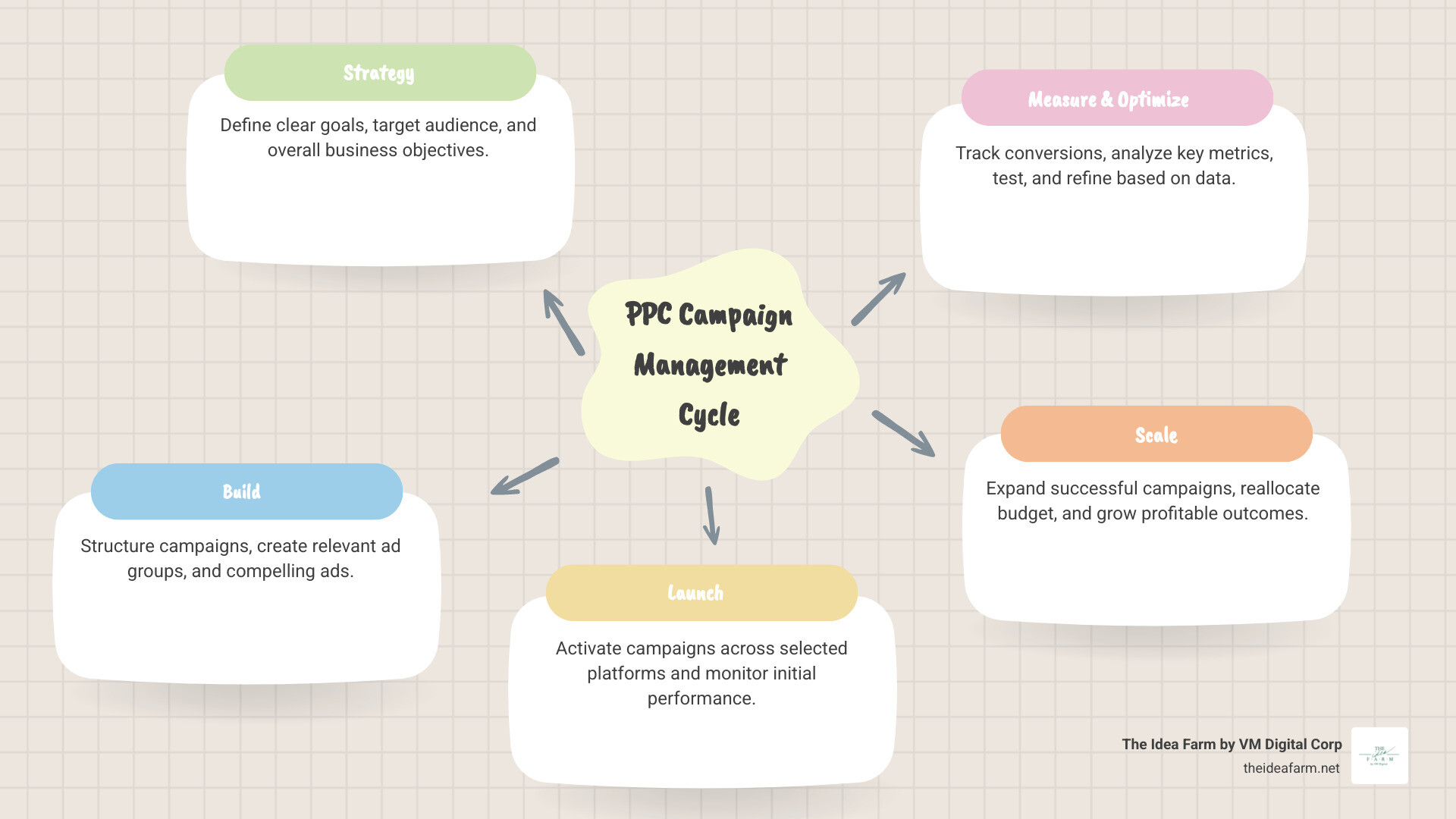
Sowing the Seeds: Architecting Your PPC Growth System
At its heart, PPC campaign management is the comprehensive and continuous process of overseeing and optimizing a company's pay-per-click advertising campaigns to achieve specific business objectives. It's a dynamic, data-driven discipline that demands expertise, vigilance, and a deep understanding of advertising platforms to ensure every dollar spent delivers maximum return on investment (ROI). Simply put, we're talking about a method of charging for advertising on the internet where advertisers pay the publisher when someone clicks on their ad. You can read more about it here: What is Pay-per-click?.
Why is this important for businesses? Because it allows us to precisely target potential customers at the exact moment they're searching for our products or services, whether they're in Houston, TX, or Danville, Kentucky. This precision means less wasted ad spend and a higher likelihood of connecting with ready-to-buy users.
Our role as growth partners is to help you architect a PPC campaign management system that's built for consistent, scalable growth. This begins with understanding your business objectives, designing a robust campaign structure, and selecting the right platforms to reach your audience.
Setting Strategic Foundations
Before we even think about keywords or bids, we start with strategy. What are we trying to achieve? Is it brand awareness, lead generation, or direct sales growth? For a high-end fashion retailer, it might be limiting ads to users in the top 10% of earnings; for a restaurant, it's about reaching those within close geographic proximity in Houston or Danville.
Our approach to PPC campaign management emphasizes clear, measurable goals. This means:
- Clear Goals: Defining precisely what success looks like, whether it's a specific number of leads, a target cost-per-acquisition (CPA), or a desired return on ad spend (ROAS).
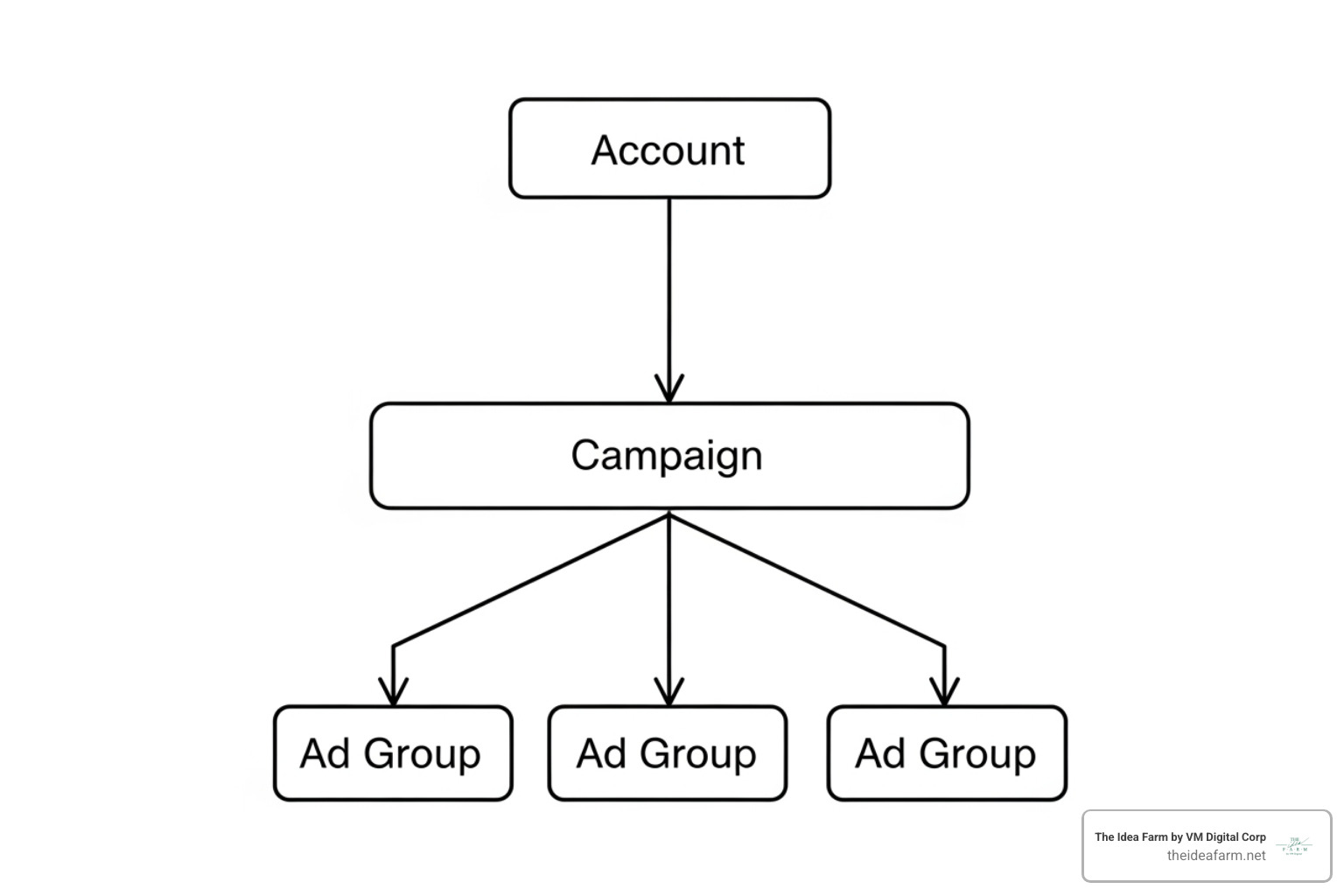
- Logical Hierarchy: Structuring campaigns in a way that makes sense, typically following an Account > Campaign > Ad Group > Ads > Keywords hierarchy. This ensures that every part of your campaign is organized and optimized.
- Budget Allocation: Setting a realistic budget and allocating it strategically across campaigns and ad groups. For brand new campaigns, we often recommend starting with a $10–$50 daily budget to gather initial data, then scaling up based on performance.
- Scalability: Building campaigns with the future in mind, ensuring they can grow and adapt as your business expands.
The digital landscape offers a buffet of advertising platforms, each with its own flavor and audience. Our job in PPC campaign management is to help you choose the right ones.
Search vs. Display vs. Social:
- Search Engine Ads (like those on major search engines) are fantastic for capturing demand. People are actively searching for solutions, and we want our ads to be right there.
- Display Ads are great for building brand awareness and remarketing (showing ads to people who've already visited your site). These ads can reach over 90% of internet users worldwide.
- Social Media Ads offer incredible targeting capabilities based on demographics, interests, and behaviors. They're perfect for introducing your brand to new audiences or nurturing leads.
Major Ad Networks: While we won't name specific platforms, most major ad networks offer robust tools for PPC campaign management, allowing us to reach audiences across various channels.
- Audience Intent: Understanding why someone is on a particular platform helps us tailor our approach. Are they actively researching (search)? Browsing casually (social)? Or consuming content (display)?
- Platform Nuances: Each platform has its own bidding models, ad formats, and audience behaviors. Effective PPC campaign management means understanding these nuances and adapting our strategy accordingly. For example, some platforms might have lower average costs per click, offering different opportunities for our clients in Houston and Danville.
Cultivating Engagement: Core Components of Effective PPC Management
Once the foundation is set, we move into the cultivation phase of PPC campaign management. This is where we craft the messages and experiences that turn clicks into conversions.

Mastering Keyword Research and Selection
Keywords are the backbone of any successful search ad campaign. They are the words or phrases people use when looking for products, services, or information online. But it's not just about finding popular keywords; it's about finding the right keywords.
- Search Intent: We dive deep into understanding what users are really looking for when they type a query. Are they ready to buy, or just researching?
- Long-Tail Keywords: These are longer, more specific keyword phrases (typically three to four words). While they might have lower search volume, they often indicate higher purchase intent and can lead to higher conversion rates. For small-to-midsized businesses in Kentucky or Texas, long-tail keywords can be a goldmine, helping to avoid intense competition from larger brands.
- Negative Keywords: Arguably one of the most powerful tools in PPC campaign management, negative keywords prevent our ads from showing for irrelevant searches. For example, if we're selling high-end software, we might add "free," "jobs," or "reviews" as negative keywords to filter out non-commercial traffic and save budget.
- Keyword Tools: We leverage powerful tools like Google’s Keyword Planner to identify relevant terms, analyze search volumes, and estimate costs.
- Competitor Analysis: We regularly analyze competitor strategies to identify gaps and opportunities, ensuring our clients stand out.
- Relevance: A core principle: keywords must be highly relevant to our ads and landing pages. This is crucial for achieving a good Quality Score, which can lead to lower costs and better ad positions.
Crafting High-Converting Ads and Landing Pages
An ad's job is to get the click; a landing page's job is to convert. Both must work in perfect harmony.
- Compelling Headlines: We craft headlines that grab attention and include keywords, often using dynamic keyword insertion to make them hyper-relevant to the search query.
- Strong Call-to-Action (CTA): Every ad needs a clear, persuasive CTA that tells the user exactly what to do next, whether it's "Download Now," "Get a Free Quote," or "Shop Services."
- Ad Extensions: These are extra bits of information that appear with your ad, like phone numbers, site links, or location details. They improve ad visibility, provide more information, and can boost your Ad Rank.
- Relevance (Message Match): This is critical. If a user clicks an ad for "red running shoes," they should land on a page specifically about red running shoes, not a generic shoe category. This "message match" reduces bounce rates and improves conversion rates.
- Conversion Rate Optimization (CRO): We continuously test different elements of ads and landing pages to improve the percentage of visitors who complete a desired action. This includes everything from button colors to form fields. A/B testing is our secret weapon here, allowing us to display ad variations to our audience to test which version leads to a higher clickthrough rate (CTR) and better conversions.
- For our clients, creating effective website systems, including optimized landing pages, is paramount. Learn more about our approach to Building effective website systems.
Managing the Harvest: Measurement, Bidding, and Optimization
The real magic of PPC campaign management lies in the continuous cycle of measurement, analysis, and optimization. This is where we ensure every advertising dollar is working hard for our clients in Houston and Danville.
Effective Bid Management and Budgeting Strategies
Bidding is where strategy meets the market. It's about telling the ad platforms how much we're willing to pay for a click or a conversion.
- Manual Bidding: This involves setting bids ourselves, offering granular control. It's often used when we have very specific performance targets or limited data.
- Automated Bidding: Leveraging the power of artificial intelligence, automated strategies adjust bids in real-time to achieve specific goals (e.g., maximize conversions, hit a target ROAS). While powerful, it still requires human oversight to guide the AI towards strategic business outcomes.
- Cost-Per-Click (CPC): Most businesses pay $1 to $2 per click on search ads, while the average CPC for display ads is $1 or less. Our goal is always to get the most valuable clicks at the lowest possible cost.
- Cost-Per-Acquisition (CPA): This is a crucial metric for us. It tells us the cost of acquiring a customer or lead. Our focus is always on driving profitability, ensuring the CPA aligns with our clients' business models.
- Budget Allocation: We carefully monitor budget pacing throughout the month, shifting funds from underperforming campaigns to top performers to maximize results. For new campaigns, Google recommends starting with a $10–$50 daily budget, allowing us to gather data efficiently before scaling.
"If you can't measure it, you can't improve it." This adage is particularly true in PPC campaign management.
- Conversion Tracking: This is non-negotiable. We set up accurate conversion tracking to measure business-critical actions, whether it's a form submission, a phone call, or an online purchase. Without it, we're flying blind.
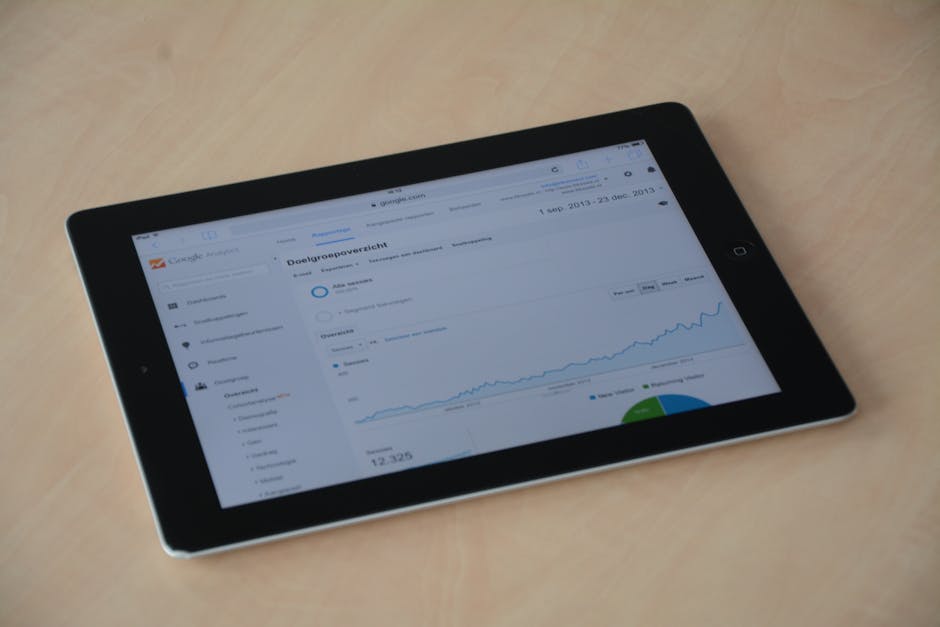
- Analytics Tools: We integrate with tools like Google Analytics to collect data about website visitors, their behavior, and how they interact with our ads and landing pages. This provides invaluable insights into the full customer journey.
- Key Metrics: We obsess over key performance indicators (KPIs) such as:
- Click-Through Rate (CTR): The percentage of people who see your ad and click it. A higher CTR often indicates ad relevance.
- Quality Score: A metric (from 1-10) that measures the quality and relevance of your keywords, ads, and landing pages. A higher Quality Score can lead to lower costs and better ad positions.
- Return on Ad Spend (ROAS): The revenue generated for every dollar spent on advertising. This is often the ultimate measure of profitability for our clients.
- Data-driven Decisions: Our approach is all about translating complex data into actionable insights. We use our The Growth Dashboard to visualize performance, spot trends, and make informed decisions that drive growth for your business. This allows us to continuously optimize targeting, bids, and ad creatives.
Scaling the Farm: Professional PPC Campaign Management
PPC campaign management is often described as an "evolving art" where perfect optimization is the objective, though not always achievable. It's a field that demands constant learning, adaptation, and significant time investment. This is why many businesses, from startups to established enterprises in Houston and Danville, consider professional help.
The Benefits of Professional PPC Management Services
For many business leaders, the thought of dedicating hours to PPC campaign management on top of their core responsibilities is daunting. This is where professional services, like ours, shine.
- Avoiding Costly Mistakes: The learning curve in PPC can be expensive. Mismanaged keywords, poor ad copy, or incorrect bidding strategies can quickly deplete budgets with little to show for it. We help you avoid these pitfalls.
- Strategic Oversight: We bring a high-level, leadership perspective to your digital advertising, ensuring your PPC efforts are aligned with your overarching business goals.
- Continuous Optimization: We don't just set up campaigns; we relentlessly monitor, test, and refine them. This includes regular A/B testing of ads and landing pages, analyzing search term reports for new negative keywords, and adjusting bids to maximize ROI.
- Scaling Campaigns: As your business grows, your PPC needs evolve. We have the expertise to strategically scale your campaigns, expanding reach and increasing ad spend effectively without sacrificing efficiency.
- Improved ROI: Our ultimate goal is to generate a positive and predictable ROI for your advertising spend. We leverage advanced tools and deep expertise to ensure your campaigns are as profitable as possible. You can explore More info about digital ads services we offer.
Is Professional PPC Management Right for Your Business?
Deciding whether to hire a PPC campaign management company is a strategic business decision. Here are some signs that a partnership might be the right path for your business in Houston, TX or Danville, Kentucky:
- In-house limitations: You lack a dedicated in-house advertising team, or your current team is stretched thin.
- Lack of time or expertise: You or your team don't have the time, specialized knowledge, or access to the necessary database and software systems to manage PPC effectively. Google Ads campaign management alone can require hours of work.
- Stagnant results: Your current campaigns aren't delivering the desired leads, sales, or ROI.
- Desire to scale growth: You're looking to significantly grow your business and need a robust, scalable advertising strategy.
- Complex accounts: Your campaigns involve multiple products, services, geographic targets, or platforms, making DIY management overwhelming.
If your goal is consistent, scalable growth and you want to ensure your advertising budget is working as hard as possible, a professional PPC campaign management partner can be an invaluable asset.
Frequently Asked Questions about PPC Management
We often encounter these questions from business leaders exploring PPC campaign management:
What are the first steps in managing a PPC campaign?
The first steps involve defining clear business objectives, conducting thorough keyword research, understanding your target audience, and establishing a logical campaign structure before spending any money. We start by asking: What specific results do we want to achieve for our clients in Houston or Danville? This clarity guides every subsequent decision.
How much should I spend on PPC?
Your budget depends on your industry, goals, and competition. For new campaigns, it's wise to start with a modest daily budget (e.g., $25–$50) to gather data, then scale based on performance and ROI. This allows us to test the waters, collect crucial performance data, and fine-tune our approach without overcommitting.
How long does it take to see results from PPC?
While you can see traffic almost instantly once campaigns launch, achieving profitable results and a positive ROI can take 3-6 months of consistent management, testing, and optimization. PPC is not a "set-it-and-forget-it" solution; it's an ongoing process that requires continuous refinement to truly flourish.
From Tactics to a Growth Engine
As we've explored, PPC campaign management is far more than just buying clicks. It's about building a robust, data-driven growth system where every dollar spent is an investment in your business's future. It's an evolving art that blends strategic thinking, meticulous execution, and continuous optimization.
At The Idea Farm, we believe marketing should be a growth engine, not just an expense. We help business leaders like you in Houston, TX, and Danville, Kentucky, transform your digital advertising from a collection of tactics into a powerful, predictable system that delivers tangible results.
If you're ready to move beyond scattered marketing efforts and cultivate a truly scalable growth system for your business, we're here to help. Partner with a Fractional CMO to build your growth system and let us help you turn clicks into conversions and drive sustainable success.