
April 13, 2026

A startup growth expert is a specialist who helps early-stage and scaling companies grow revenue faster by building the right systems, channels, and strategies for their stage.
Here is what to look for when finding one who delivers real results:
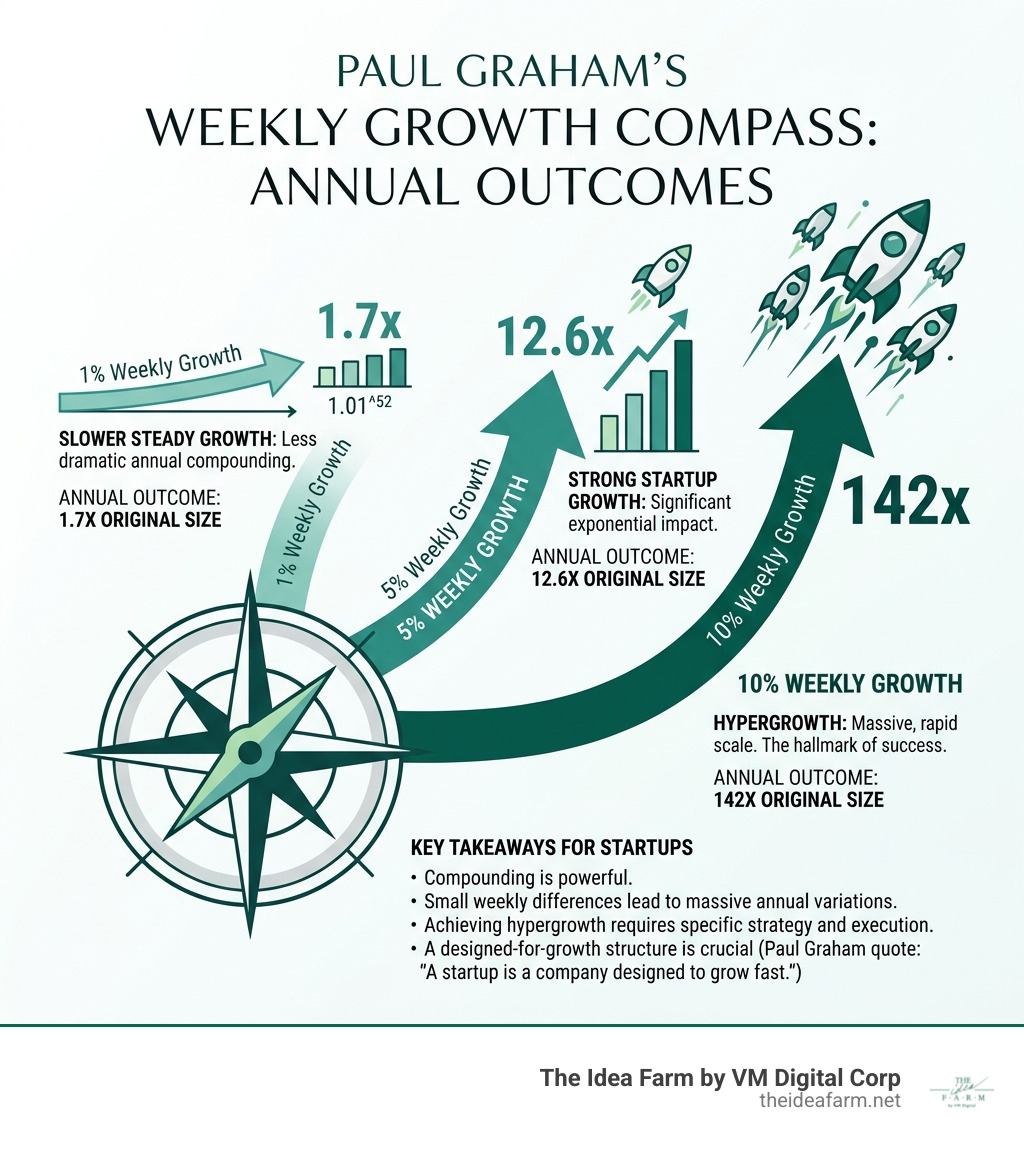
Growth is not just a goal for startups. It is the core function. As Y Combinator's Paul Graham put it: "A startup is a company designed to grow fast." A company growing at just 5% per week will be 12.6 times larger by the end of the year. That kind of compounding does not happen by accident. It happens when the right expert is aligned to the right stage with the right systems.
But here is the problem most founders face: the market is flooded with people calling themselves growth experts. Some are genuinely exceptional. Others are expensive and slow. And a bad hire or engagement does not just cost money. It costs months of momentum.
This guide was built to help you cut through the noise. We have pulled together research on the top individual advisors, fractional leaders, platforms, and agencies so you can make a faster, smarter decision.
I'm Jose Escalera, CEO of The Idea Farm by VM Digital, and I have spent my career helping early-stage and scaling businesses align strategy, marketing, and sales into systems that produce real commercial results. That hands-on background in company building is exactly what informs how I think about finding and working with a startup growth expert. In the sections below, we will break down exactly what to look for, who to consider, and how to avoid the most common and costly mistakes.
Startup growth expert basics:
A true startup growth expert is not just a marketer. They are a blend of a data scientist, a product strategist, and a commercial operator. They understand that Startup Growth Marketing is about more than just getting clicks. It is about building a repeatable engine that turns capital into more capital.
In our experience at The Idea Farm, these experts possess a specific "Growth DNA." They do not look at marketing in a vacuum. Instead, they look at the entire funnel. They ask how the product helps users invite other users. They look at how pricing affects retention. They are obsessed with the math of the business.
When you look for Business Growth Experts, you are looking for people who have "seen this movie before." They know the pitfalls that happen at $1M ARR and the shifts needed to reach $10M. They do not guess; they experiment.
The primary role of these specialists is to provide two things: tactical guidance and strategic oversight. In the early days, a founder often acts as the primary salesperson and marketer. But eventually, that hustle hits a ceiling.
A startup growth expert helps you break through that ceiling by:
At The Idea Farm, we believe in the "Growth Compass" popularized by Paul Graham. For a startup, growth is the only metric that truly matters because it validates everything else. If you are growing, your product is likely solving a real problem.
Consider the math of weekly growth:
Focusing on these weekly numbers acts as a filter for decision-making. If an activity does not help you hit your weekly target, you stop doing it. This is why groups like Seed Round Capital in Houston focus so heavily on these metrics when evaluating early-stage companies.
Hiring for growth is not a one-size-fits-all situation. Depending on your budget and your needs, you might need a leader to run the whole show or a specialist to fix one specific problem. This is where Fractional CMO Services and specialized consultants come into play.
A Fractional CMO is a senior-level executive who works for your company part-time. This is often the best move for startups with between $1M and $5M in revenue. You get 20 years of experience for a fraction of the cost of a full-time hire.
The benefits of hiring a fractional Growth Marketing Consultant include:
Sometimes you do not need a leader; you need a surgeon. Project-based experts are perfect for solving specific bottlenecks. Common projects include:
Programs like Startup Stage: Accelerate at the University of Houston often connect founders with these types of specialists to help them refine their Customer Acquisition Strategy.
The startup growth expert you need today is likely not the one you will need in two years. Your challenges change as your revenue grows. You need to match the expert's skills to your current ARR (Annual Recurring Revenue) stage.
In the pre-revenue stage, growth is about one thing: Product-Market Fit (PMF). You do not need a "scale" expert yet. You need someone who is great at customer discovery.
At this stage, look for someone who can help with:
Local resources like Accelerators & Incubators in Kentucky provide a great starting point for pre-revenue founders looking for this type of foundational mentorship.
Once you hit $1M ARR, the game changes. You have a product people want. Now you need Growth Marketing Systems that are predictable. This is the "Scale Up" phase.
In April 2026, the focus for these companies is often on:
Organizations like SOAR Innovation in Eastern Kentucky focus on helping regional businesses implement these types of high-level systems to compete on a national level. For a deeper dive into how agencies handle this transition, see our Growth Marketing Agency Complete Guide.
Pricing for a startup growth expert can vary wildly. However, most engagements fall into three buckets. Understanding these helps you budget correctly and set expectations for ROI.
| Model | Typical Monthly Cost | Engagement Length | Best For |
|---|---|---|---|
| Fractional CMO | $5,000 - $15,000 | 6 - 12 Months | Strategic leadership & team building |
| Project-Based | $10,000 - $50,000 (Total) | 1 - 3 Months | Specific fixes (e.g., GTM launch, SEO setup) |
| Retainer/Advisory | $3,000 - $8,000 | Ongoing | High-level guidance & accountability |
When hiring through Fractional CMO Services, the goal is often to save money. Research shows that working with a consultant can save a startup over $200,000 in the first year compared to hiring a full-time executive with the same experience level.
Not every startup growth expert is a good fit. In our work at The Idea Farm, we have seen founders lose months of time by following the wrong advice. Watch out for these red flags:
ROI should be measured by the increase in your core North Star metric—usually monthly recurring revenue (MRR) or sales-qualified leads (SQLs). A good expert should pay for themselves within 3 to 6 months by either increasing revenue or significantly reducing your wasted ad spend. For example, some experts have helped companies generate $10,000 in recurring revenue from just $5,000 in ad spend in their first month.
A mentor is usually someone you meet with casually for general career or leadership advice. They are often unpaid. An advisor is a formal role. They are "in the weeds" with you, looking at your data, helping with strategy, and are usually compensated with a monthly fee or equity.
While some "quick wins" (like fixing a broken landing page) can show results in days, a real growth engine takes time. Expect 30 days for audit and strategy, and another 60 to 90 days to see significant, statistically relevant changes in your growth rate.
Finding the right startup growth expert is one of the most important decisions a founder can make. Whether you are in Houston, TX, or Danville, KY, the principles of scaling remain the same: you need data-driven systems, senior strategy, and a relentless focus on the metrics that matter.
At The Idea Farm, we don't believe in "hacks" or "silver bullets." We believe in building connected marketing systems that are tailored to your specific goals and numbers. Scaling a business is hard, but it is much easier when you have a partner who has navigated the path before.
If you are ready to move past founder-led hustle and start building a scalable engine, it might be time to look into How to hire a Fractional CMO who can lead that transition for you. Growth is a science—make sure you have the right scientist in your lab.