

March 2, 2026

Improve marketing ROI isn't just about spending less or getting more leads. It's about building a system that connects every dollar spent to measurable business outcomes—and most companies are doing it backwards.
Here's what actually improves marketing ROI:
The problem isn't that businesses don't want better ROI. It's that they're measuring it in ways that hide the truth. They credit the wrong channels. They ignore time lag. They optimize for metrics that don't correlate with revenue. And they make budget decisions based on incomplete data.
68% of marketing professionals feel more pressure to prove ROI, according to Adobe research. Yet just over half are confidently tracking it. The gap isn't a measurement problem—it's a systems problem.
When you can't see which touchpoints actually drive revenue, you can't allocate budget effectively. When your tracking misses 30% of conversions due to browser restrictions, your ad platforms optimize on bad data. When you treat all customers the same instead of segmenting by value and behavior, you waste money on low-intent audiences.
Most marketing advice treats ROI improvement as a tactical challenge: tweak your ad copy, try a new channel, run more tests. But sustainable ROI gains come from building better infrastructure—unified tracking, multi-touch attribution, audience segmentation, and cross-channel measurement systems that actually capture the full picture.
This isn't about working harder. It's about building systems that compound.
I'm Jose Escalera, CEO of The Idea Farm, and I've spent my career building companies across different sectors, which taught me that marketing only works when it's designed as a commercial system, not a creative exercise. Throughout this guide, I'll show you how to improve marketing ROI by fixing the foundational issues most businesses don't realize they have.
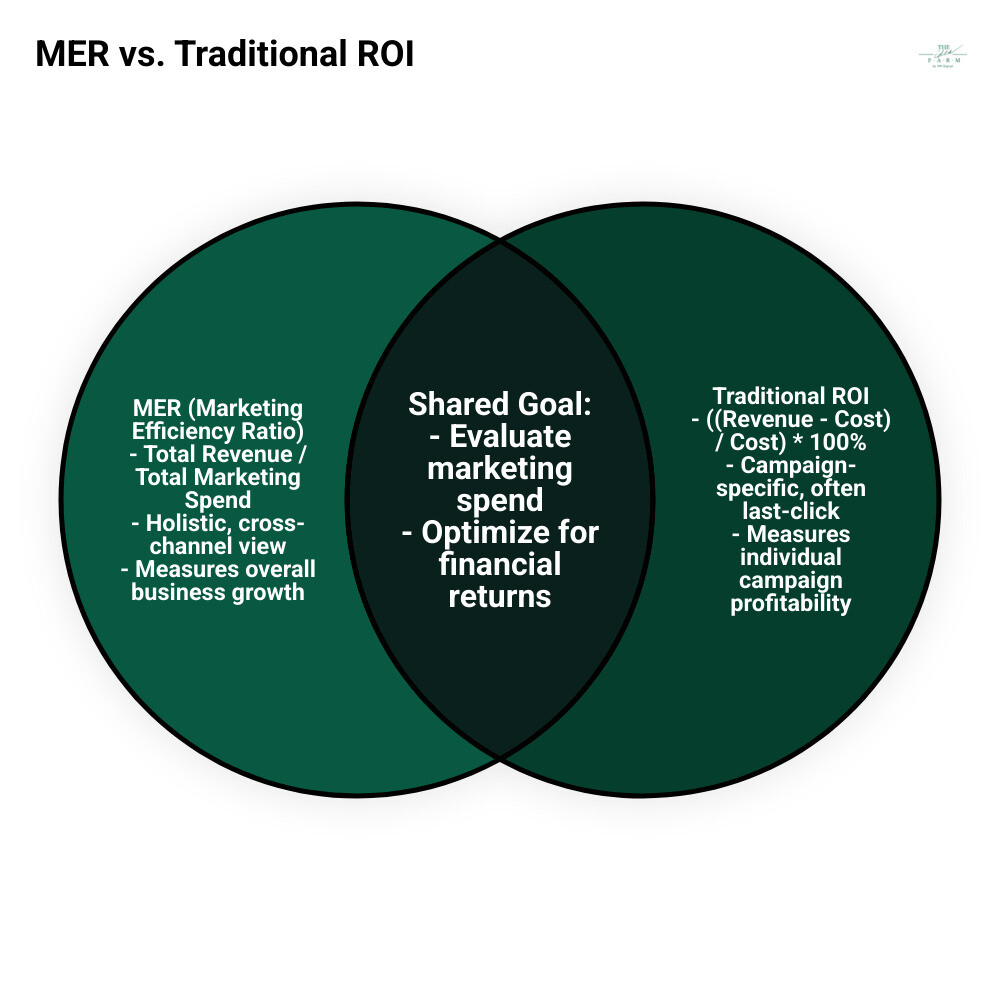
What exactly is marketing ROI, and why is it the bedrock of every successful business strategy? At its core, marketing ROI is the revenue or profit you gain from your marketing activities. It's the ultimate report card, showing how marketing spend impacts your company's financial success. A positive return means your campaigns are bringing in more than they cost, which, let's be honest, is the whole point.
But here's where most businesses stumble: they confuse traditional, campaign-specific ROI with a more holistic view. Traditional ROI often focuses on individual campaigns, calculating ((Revenue - Marketing Cost) / Marketing Cost) * 100%. This is useful for micro-optimization, but it rarely tells the full story of your marketing ecosystem.
This is why we advocate for metrics like the Marketing Efficiency Ratio (MER). MER takes your total sales revenue for a specific period and divides it by your total marketing spend for the same period. It provides a high-level, blended view of your marketing's overall efficiency, indicating the health of your entire marketing budget. While a digital marketer might aim for an average ROI of 5:1 (meaning $5 gained for every $1 spent), and anything below 2:1 is generally not profitable, MER helps us understand the aggregate effect across all channels.
Why is this crucial? Because in today's fragmented landscape, customers interact with your brand across numerous touchpoints before converting. Relying solely on individual campaign ROI can lead to misallocating resources, underfunding channels that contribute to early-stage awareness, and overfunding those that simply close the deal. We need to measure not just immediate returns, but also the long-term value generated by customer relationships, often best captured by Customer Lifetime Value (CLV). Understanding CLV helps us assess the true profitability of acquiring and retaining customers, rather than just the initial transaction.
For a deeper dive into how we connect these dots, check out our insights on growth dashboards.
To truly improve marketing ROI, we need a robust measurement framework. This isn't just about plugging numbers into a formula; it's about setting up a system that provides actionable insights.
First, we need to establish clear, measurable Key Performance Indicators (KPIs) that align with our business goals. We use KPI forecasting, which involves data analysis and predictive modeling, to anticipate future performance issues before they impact results. This allows us to proactively take corrective action and improve our hit rate for reaching targets. For instance, if our forecast predicts a dip in lead quality next quarter, we can adjust our targeting or messaging now, rather than reacting later.
Next, we define SMART goals for our marketing efforts. These are Specific, Measurable, Achievable, Relevant, and Time-bound objectives that provide a clear target for every campaign and channel.
A critical component of this framework is choosing the right attribution model. The traditional last-click attribution model, which gives all credit to the final touchpoint before a conversion, is woefully inadequate for modern businesses. It dramatically undervalues awareness and consideration-stage channels, leading to misallocated budgets and missed opportunities. Instead, we need to consider multi-touch attribution models:
| Attribution Model | Description | Pros | Cons |
|---|---|---|---|
| Last-Click | 100% credit to the last touchpoint. | Simple to implement and understand. | Ignores all prior touchpoints, undervalues awareness. |
| First-Click | 100% credit to the first touchpoint. | Highlights initial findy efforts. | Ignores all subsequent touchpoints, undervalues conversion drivers. |
| Linear | Equal credit to all touchpoints in the conversion path. | Fairly distributes credit, acknowledges all interactions. | Doesn't account for varying impact of different touchpoints. |
| Time Decay | More credit to touchpoints closer to the conversion. | Recognizes that recent interactions are often more influential. | Still can undervalue early-stage efforts, especially in long sales cycles. |
| Position-Based | Assigns 40% credit to the first and last interactions, with the remaining 20% distributed evenly to middle interactions. | Balances initial findy and final conversion, acknowledges middle steps. | Can be complex to implement, specific percentages may not fit all businesses. |
| Custom | Custom credit distribution based on business insights and data. | Most accurate reflection of unique customer journeys. | Requires significant data analysis and expertise to define and maintain. |
The modern customer journey is rarely linear. A customer might find us through social media, read our blog over several weeks, and finally convert through a paid search ad. How do we accurately credit each of these channels? This is where navigating multi-channel complexity becomes paramount.
We use marketing mix modeling to understand the contributions of various marketing channels to customer acquisition and revenue. This involves analyzing a blend of online and offline activities to make smarter investment decisions. For example, while email marketing might drive immediate sales (with an impressive average ROI of $36 for every $1 spent), SEO could generate higher lifetime value customers (with an average return of 22:1). Our goal is to balance these short-term gains with long-term strategic investments.
Another key metric we track is branded search lift. This measures the increase in searches for our brand name directly attributable to our marketing efforts, indicating a rise in brand awareness and demand. These are the nuances that differentiate a tactical approach from a strategic one. To help businesses like yours untangle these complexities, we offer dedicated strategy sessions to map out your unique path to growth.
The foundation of truly effective marketing ROI isn't just about what you measure, but how accurately you collect the data. Data collection and analysis play an indispensable role in improving marketing ROI. Without clean, comprehensive data, our analytics are flawed, our optimizations are guesses, and our budgets are wasted.
Consider the challenge: traditional browser-based tracking (using cookies, pixels, and JS tags) is increasingly unreliable due to browser restrictions, ad blockers, and privacy regulations. This leads to significant data loss, meaning your ad platforms are optimizing based on incomplete information. The result? Higher costs, lower performance, and a murky picture of your actual ROI.
This is where server-side tracking becomes a game-changer. Instead of data being sent directly from the user's browser to third-party platforms, it's first sent to your server, then forwarded to the respective platforms. This method captures more conversions, provides cleaner data, and improves ad platform performance.
The results are compelling:
For a deeper dive into the technicalities, check out Stape’s webinar on Server-Side Tracking Done Right. It’s not just a technical fix; it’s a strategic imperative for anyone serious about digital ads. We build robust digital ad systems that leverage these advanced tracking methods.

In an era of increasing privacy concerns and third-party cookie deprecation, first-party data is your most valuable asset. This is data you collect directly from your customers with their consent, giving you unparalleled insights into their preferences and behaviors.
By sending this first-party data directly from your cloud server via Conversions API (CAPI), you provide ad platforms like Meta and Google with a richer, more accurate data set. This allows their algorithms to optimize your campaigns more effectively, leading to better targeting, lower costs per conversion, and ultimately, a higher ROI.
One powerful application of first-party data is micro-segmentation. This involves using advanced clustering algorithms to divide your customer base into highly specific groups with similar characteristics. Instead of broad segments, you might identify 'eco-conscious urban dwellers who prefer online purchases' or 'small business owners in Houston, TX, interested in specific SaaS solutions.' This enables hyper-personalized marketing approaches. By understanding these behavioral patterns, we can tailor messaging, offers, and even channel selection to resonate deeply with each micro-segment.
Consistent naming conventions are also critical here. Without them, your campaign data fragments, making it impossible to compare performance accurately. For example, if one team names a campaign "SummerSale" and another names it "Summer_Sale," your reports will show two separate campaigns, hindering unified analysis. Aligning on a standardized naming structure ensures that all your data contributes to a cohesive picture, leading to better marketing ROI. This level of strategic oversight is what defines our fractional CMO services.
The digital landscape is constantly evolving, with browsers like Safari and Firefox (and soon Chrome) implementing stricter privacy features that limit cookie lifespan and block third-party tracking. This directly impacts our ability to accurately measure campaign performance and optimize ad spend.
Server-side tracking directly addresses these challenges by:
For businesses in Houston or Danville, where local market nuances are critical, robust tracking isn't just a best practice—it's a competitive advantage. We help businesses fortify their website systems to ensure maximum data integrity.
Content is no longer just about informing; it's about engaging and converting. To improve marketing ROI, we need content that actively improves lead capture and conversion rates. Static content, while foundational, often falls short in today's demanding buyer's journey.
The statistics bear this out: interactive content converts 2x better than static content. Why? Because prospects are increasingly reluctant to share personal information for underwhelming content. A DemandGen Report found that among B2B buyers in 2015, only 11% would give up personal information for a whitepaper—a number that was already down significantly from the previous year. Buyers want value, and they want to feel a connection before they commit.
Content marketing contributes to overall marketing ROI by building brand awareness, establishing thought leadership, generating leads, and nurturing prospects through the sales funnel. It's a long-term play, but its compounding effects on ROI are undeniable.
Creating high-quality, engaging content consistently is a massive undertaking. This is where licensed content can be a powerful accelerator. Instead of always reinventing the wheel, we can leverage expertly crafted, pre-existing content from reputable sources.
The benefits of using licensed content to improve content marketing ROI are manifold:
Think of it as having an editorial team of experts at your fingertips. To dive deeper into this strategy, we recommend downloading the whitepaper, "7 Ways Licensed Content Can Boost Your Content Marketing ROI".
Interactive content isn't just a novelty; it's a strategic tool to gather deeper insights and improve conversion rates. Instead of simply asking for contact information, interactive experiences offer value in exchange for engagement.
Consider:
Interactive content fosters a "conversational" approach to data collection. Instead of inferring intent from clicks, you're asking direct questions within an engaging experience. This allows you to build a more nuanced prospect profile, speeding up the sales process by equipping your sales team with rich, personalized insights. For more on this, explore the guide, "Interactive Content and the Buyer’s Journey."
Even with perfect data, inefficient ad spend can cripple your ROI. Optimizing ad spend across different platforms like Google Ads and Meta (Facebook/Instagram) is about more than just reducing costs; it's about maximizing impact. PPC advertising, while effective, has an average ROI of around 200%, highlighting the constant need for optimization.
One of the biggest culprits of wasted ad spend is poor targeting. For example, poor geo-targeting can waste up to 65% of your ad budget. If you're a local business in Danville, KY, advertising to an entire state, you're throwing money away. We need to be precise, identifying specific locations that correlate with purchase intent. This might mean setting geo-fences around specific neighborhoods in Houston, TX, where your ideal customers live or work.
Maximizing marketing ROI in a multi-channel world demands a unified approach to budgeting. Cross-channel budgeting ensures that our ad dollars are allocated where they will have the greatest impact, rather than siloed by platform.
Key strategies include:
Advanced techniques like conversion path analysis and cross-device matching also play a vital role. Most users today interact with brands across at least 2-3 devices before converting. Cross-device matching identifies and connects user activity across smartphones, tablets, and computers, creating a unified customer profile and journey map. This prevents fragmented sessions from appearing as unique users, ensuring you're not wasting budget on excessive impressions or distorting campaign performance metrics. Conversion path analysis, on the other hand, helps us understand the typical sequence of touchpoints that lead to a conversion, allowing us to allocate credit more accurately than last-click models.
Once we have clean data and a unified budget, the next step is to ensure we're reaching the right people. This means focusing our ad spend on high-value audience targeting.
By combining these strategies, we ensure that every dollar spent is directed towards the audiences most likely to convert, driving a higher marketing ROI. We continuously refine these strategies within our digital ads systems.
While specific targets can vary by industry, channel, and business model, a common benchmark digital marketers aim for is a 5:1 return – meaning $5 in revenue for every $1 spent. An ROI below 2:1 is generally considered unprofitable. However, some channels naturally yield higher returns. For example, email marketing consistently delivers an impressive average ROI of $36 for every $1 spent, or up to 3,600%. SEO marketing, a long-term play, can see an average return of 22:1, or 2,200% ROI. PPC advertising typically offers an average ROI of 200%. The key is to understand what's achievable for each channel and optimize accordingly.
Server-side tracking directly impacts ad performance by providing ad platforms with more accurate and comprehensive data. When data is sent from your server rather than the user's browser, it bypasses many of the browser restrictions, ad blockers, and privacy settings that cause data loss. This cleaner, more complete data allows ad algorithms to make better-informed decisions for targeting, bidding, and optimization. The result is often a lower cost per conversion, higher conversion rates, and a more efficient ad spend, directly boosting your overall marketing ROI. As the case studies showed, this can lead to significant increases in reported conversions and substantial drops in cost per purchase.
Last-click attribution is failing modern businesses because it provides an incomplete and often misleading picture of the customer journey. In today's multi-touch, multi-device world, customers interact with numerous channels before making a purchase. By giving 100% credit to only the very last touchpoint, last-click attribution dramatically undervalues the crucial role that early-stage channels (like social media or content marketing) play in building awareness and nurturing interest. This leads to misallocated budgets, as businesses might cut investment in channels that generate initial demand, simply because they don't get the "last click." It hinders our ability to accurately improve marketing ROI by obscuring the true value of each interaction along the conversion path.
We've covered a lot of ground, moving beyond superficial tactics to the systemic changes required to truly improve marketing ROI. From establishing robust measurement frameworks to leveraging advanced data integrity through server-side tracking and optimizing conversion paths with intelligent content strategies, the path to compounding growth is clear. It's about building marketing as a commercial system, not a series of disconnected efforts.
What most businesses still misunderstand is that marketing ROI isn't just a metric to report; it's a strategic imperative that dictates resource allocation, future growth, and competitive advantage. The ability to accurately track, analyze, and optimize your marketing investments is no longer a luxury—it's a necessity.
At The Idea Farm, we don't just offer marketing services; we partner with you as a Fractional Growth Partner. We specialize in building connected, data-driven marketing systems custom to your numbers and goals, ensuring consistent, scalable growth in competitive markets like Houston, TX, and Danville, KY. If you're ready to stop chasing fleeting trends and start building a marketing engine that compounds, let's talk.