
March 17, 2026

Many business owners feel like they waste money on ads. They see clicks but no sales. This happens because their ads do not work together. Digital advertising campaign management is the system that fixes this. It makes sure your ads help each other. It stops your team from sending different messages to the same people.
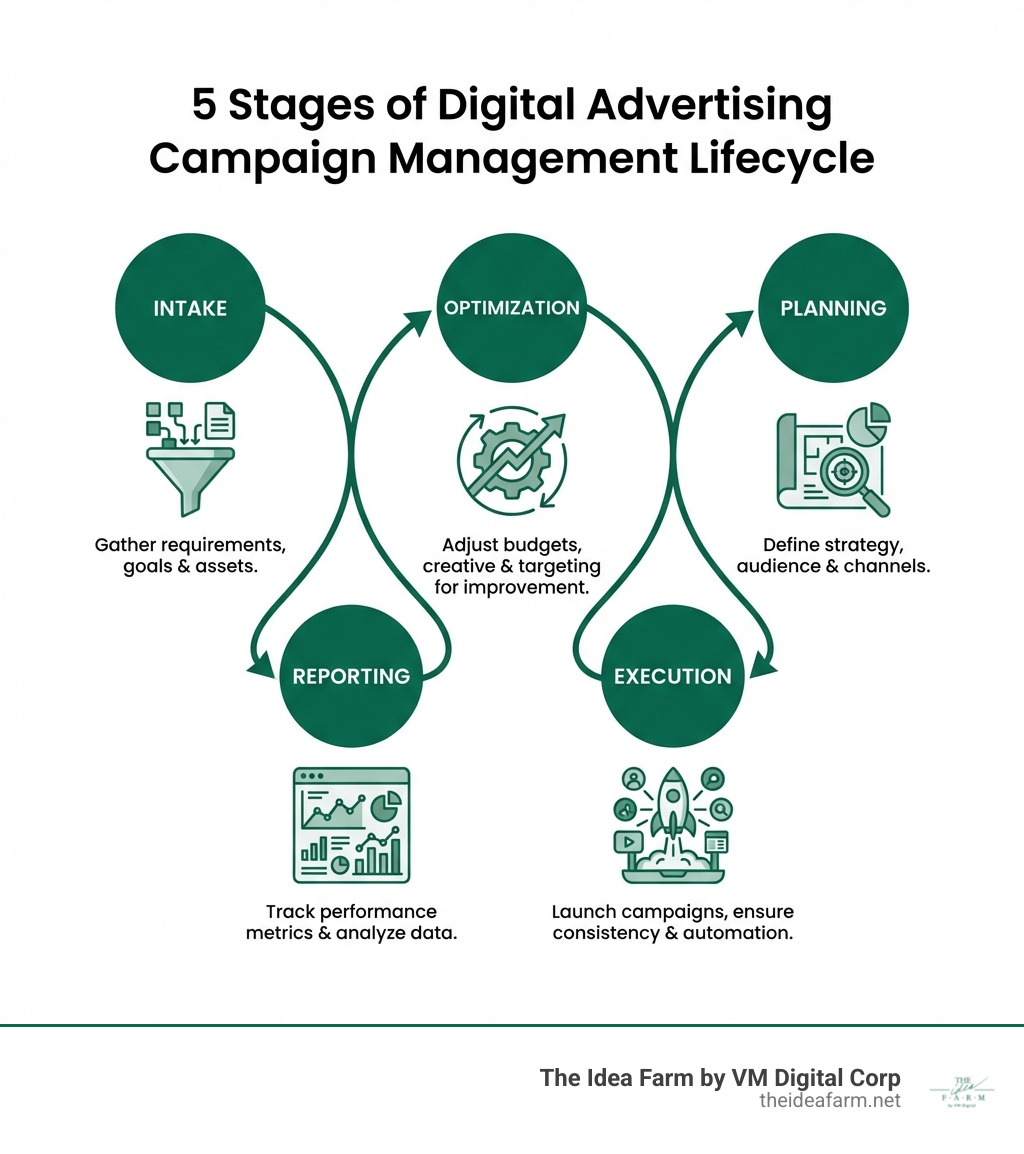
Effective digital advertising campaign management includes five steps:
Why it matters: Without a system, your ads run in separate groups. Teams waste time on slow work. Money goes to the wrong places. Reports become a mess. Research shows that AI will help the economy grow by 2030. But this only works if you have a good system to use it.
Most guides talk about pretty pictures. But the real problem is how the work gets done. Messy requests and slow sign-offs stop growth. That is where campaign management comes in. It is the hidden layer that helps you grow.
I am Jose Escalera, CEO of The Idea Farm by VM Digital. I build companies and sales systems. I have seen how good management helps businesses grow. My approach treats marketing as a tool for sales. It should create demand and show real results.
Quick digital advertising campaign management terms:
Managing ads is more than just clicking buttons. It is about looking at the big picture. You need three main parts to succeed.
Watching the big plan is the first part. This means every dollar spent must help a business goal. AI is changing how we work. But AI cannot fix a bad plan. You need a person to set the plan first.
Using money wisely is the second part. You must be smart with your cash. You cannot spend money on every new app. You need a system to decide which ads get the most money.
Keeping the same look is the third part. Your ads should look the same everywhere. If one ad looks professional but another looks messy, people get confused. Confusion stops people from buying. You can find More info about digital ads on our site to see how these parts work.
The digital world has many parts. Your customers are on TikTok, email, and Google. If your ads are not connected, you waste money. You might show the same person the same ad too many times.
A single system lets you make choices based on facts. You can see the whole path a customer takes. You can see if they clicked an ad and then bought something later. This is called mapping the customer path.
Growth is another big reason. If you want to spend more money on ads, you cannot use simple lists. You need a system that can handle the work. Without it, your team will spend all day just trying to keep up.
Management is the doing. It is the tools and the daily work. It is launching ads and checking money.
Governance is the rules. It is the plan that keeps everyone on the same page. Rules include:
Without rules, the work is just a mess. You might be busy, but you are not building a system that lasts.
A good campaign has five stages. It does not start when you hit the go button.
Planning starts with what people think of you. You need goals that are clear and easy to count.
Then, you need to know your audience. We use the 40-40-20 rule.
Most people spend too much time on the pictures. That is why they fail. You must focus on the audience first.
Making ads personal can lower your costs. This means your ads should talk to people like you know them. If you sell to a boss, use words they know. Once you have a plan, you can use More info about the growth dashboard to track your work.
You cannot manage what you do not count. You need to know your cost for each click and your return on money spent.
Testing is how you improve. You test two different titles to see which one works better. Only test one thing at a time. If you change everything, you will not know what worked.
You also have to watch for ad boredom. This happens when people see your ad too many times and stop looking. When numbers drop, it is time for new ads.
Using AI can help you find patterns. It can tell you which days are best for your ads. It can find which group of people is actually buying your product.
| Feature | Manual Work | AI Work |
|---|---|---|
| Setting Budgets | Based on a guess | Based on real data |
| Picking Audiences | Large groups | Very exact groups |
| Making Ads | Slow and manual | Fast and automatic |
| Fixing Ads | Weekly checks | Constant changes |
AI is a big part of how we grow businesses today. By 2025, many ads will be made by AI. This does not mean people go away. It means people become the bosses of the machine.
AI can move your money for you. If your Google ads are doing better than your Facebook ads today, the system can move the money. This is much faster than a person looking at a list once a week.
When you look for a tool, find one that fixes your problems.
Good features include:
For business-to-business companies, LinkedIn Campaign Manager is very helpful. It lets you pick people by their job title. This is very exact advertising.
You also want triggers. For example, if someone reads a paper, the system should tell your sales team to call them. This keeps the work moving.
Your ads should not live alone. They need to be connected to your sales tools. This gives you a full view of the customer.
Many marketers think they need more automatic tools. It helps with talking to leads. If someone clicks an ad but does not buy, you need a system to follow up.
When you connect your tools, you can track a person from their first click to the final sale. This is how you prove your ads are making money.
Good plans fail if the work is messy. We see three big problems most often:
To fix these, you need one place for all work. You need a single spot where every request starts. Using infographics can help your team see the plan before they start.
Following rules is also important. You must follow data laws. Using a privacy policy ensures you follow the rules while you track results.
Money is wasted when you talk to the wrong people. We use the 40-40-20 rule to check ads. If an ad fails, we check the audience first. Are we showing meat ads to people who do not eat meat?
Next, we check the deal. Is it actually good? A free talk is often just a sales pitch. People do not like that.
Finally, we look at credit. This is how you decide which ad gets the credit for a sale. If you only look at the last click, you might turn off the ads that started the path. That would be a mistake.
If you want to grow in new cities, you need a system. You cannot start from zero every time.
The secret is using templates. You build a campaign in a box that has the right rules and names. Then you just change the message for the new city.
This keeps your brand looking the same everywhere. It also means your reports stay clean. You can see how your ads are doing in different places without using many different lists.
The 40-40-20 rule shows what makes an ad work.
Most people focus on the 20%. That is why their ads do not work.
Rules provide the standards. They set names for ads and budgets. They decide who must say yes to an ad. This keeps the brand safe and the data clean. It lets a business grow without falling apart.
Without connecting your tools, you are guessing. You might see that an ad got 100 clicks. But you will not know if those people actually bought anything. When your ads talk to your sales tools, you can see which ads lead to real money. This lets you stop spending on clicks that do not turn into sales.
At The Idea Farm, we do not believe in marketing just to be busy. We believe in building systems that lead to growth. We act as your marketing leaders. We help you move from messy steps to a clear system.
Digital advertising campaign management is not a one time project. It is the work of making sure your marketing engine runs well. Whether you are in a big city or a small town, the goal is the same. You want clarity and results.
If you are tired of wasting money on ads, it is time for a new way. We focus on the basics that help your sales team and your profits.
Ready to stop guessing and start growing?