June 1, 2026
A digital ad campaign is a coordinated, goal-driven plan to promote your business across online channels like Google, Meta, YouTube, or LinkedIn, using targeted creative, defined budgets, and measurable outcomes.
Here is what separates a real campaign from just "running ads":
The global digital advertising market is on track to hit $786.2 billion by 2026. That is a lot of money. But most of it is not working as hard as it should.
The problem is not the platforms. It is the lack of a system behind the spend.
Most businesses jump straight to tactics: boost a post, run a search ad, test a video. Without a connected strategy, those tactics produce noise, not growth. You end up with fragmented data, wasted budget, and no clear picture of what is actually driving results.
The businesses that win with digital advertising treat campaigns like systems, not experiments. They set clear goals, build audiences with precision, test creative methodically, and measure what actually matters.
This article breaks down how those campaigns work, what makes them effective, and what you can take from the best examples to build something that scales.
I'm Jose Escalera, CEO of The Idea Farm by VM Digital, and I've spent my career building businesses and helping brands design digital ad campaign systems that connect marketing directly to revenue. The frameworks in this guide come from that hands-on experience across media, sales, and strategy.
Easy digital ad campaign glossary:

In April 2026, a digital ad campaign is more than just a few pictures on a screen. It is a strategic plan to grow your brand. We see many businesses in Houston and Danville that think they are running a campaign when they are really just buying space.
A real campaign has a clear start and end date. It uses specific messages for specific people. It does not try to be everything to everyone. Instead, it focuses on a single goal, like launching a new product or getting more sign-ups for a service.
According to research on Digital Marketing Campaigns: Types and Channels, a campaign must coordinate its creative assets and its targeting. If your message does not match who sees it, you are wasting money. We believe in building systems that make sure every dollar works toward a result. For a deeper look at high-level tactics, check out our Digital Advertising Experts Guide.
Traditional media like billboards or TV can be great for reach. But they are hard to track. Digital advertising is different for a few big reasons.
First, it gives us real-time data. We can see exactly how many people clicked an ad within minutes. If an ad is not working, we can change it right away. You cannot do that with a billboard in Houston.
Second, the targeting is much better. We can show ads only to people who are looking for exactly what you sell. This makes it very cost efficient. You only pay to reach the people who matter.
Third, the ROI is measurable. We can track a user from the first time they see an ad all the way to their final purchase. This helps us know exactly which parts of the digital ad campaign are making money.
Every successful campaign needs four main parts:
Managing these parts requires a plan. You can learn more about this in our guide on Digital Advertising Campaign Management.
Not all ads are the same. Different ads do different jobs. A good digital ad campaign often uses more than one type to get the best results.
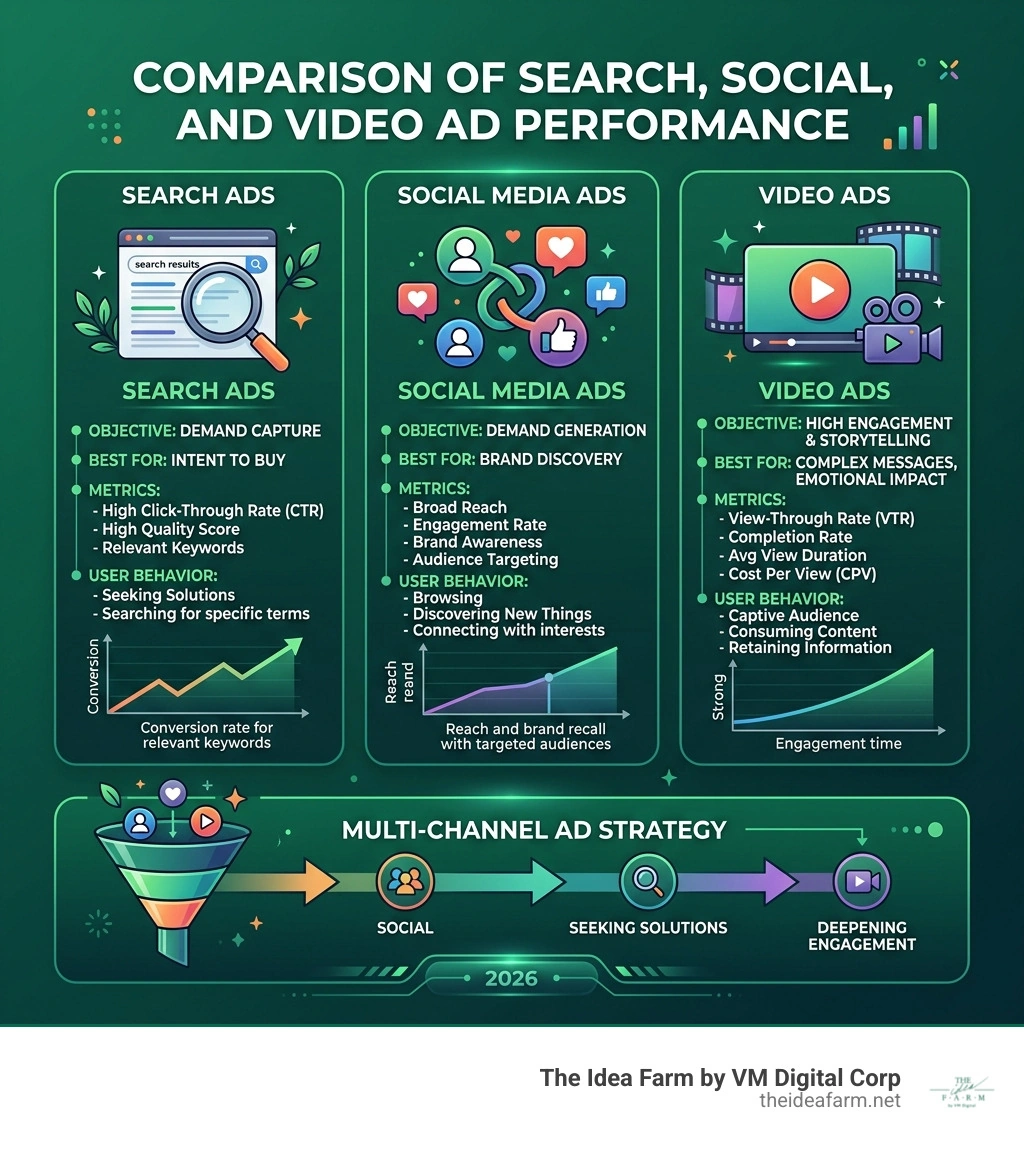
These ads show up when people search for things on Google. They are great for "demand capture." This means the person is already looking for a solution. They have high intent to buy.
Platforms like Instagram, TikTok, and LinkedIn are great for "demand generation." People are not usually searching for products here. They are browsing. These ads help them discover your brand for the first time. Social media ads are the top way people aged 16 to 24 find new brands.
Video is very powerful. Short-form video now drives the highest ROI for many marketers. It captures attention quickly and tells a story better than a static image.
Display ads are the banners you see on websites. Native ads look like part of the website content. They are good for keeping your brand in front of people as they browse the web.
For a full breakdown of how to manage these, see our page on PPC Campaign Management.
An omnichannel approach means using many channels at once. When you combine search, social, and video, you reach people at different stages of their journey.
A person might see your video on TikTok first. Then, they might see a display ad on a news site. Finally, they might search for you on Google. If your message is consistent across all these spots, they are much more likely to buy. This multi-channel approach amplifies your success.
Marketing changes fast. Here is what is working right now in 2026:
We can learn a lot from the biggest wins in history. These campaigns did not just buy ads. They created cultural moments.
During the 2013 Super Bowl, the lights went out. Oreo's team was ready. They tweeted a simple image saying "You can still dunk in the dark." It went viral instantly. This showed that being fast and clever can be better than having a huge budget.
Dove used an FBI sketch artist to draw women as they described themselves. Then, he drew them based on how others described them. The results were emotional and powerful. It got 163 million views. It worked because it touched on a real human emotion.
Every year, Spotify gives users a summary of their music. In December 2025, it reached 200 million users in just 24 hours. It generated 500 million social shares. This works because it is personalized. People love to share things that are about them.
Stanley went from $73 million in revenue in 2019 to $750 million in 2023. They did this by moving away from marketing to "outdoorsmen" and focusing on women through influencer marketing. It was a massive shift in audience strategy.
The Barbie marketing team spent $150 million but made $1.44 billion at the box office. They used 9 billion TikTok views and 3.3 billion earned media impressions. They made the movie a cultural event that everyone felt they had to join.
You can find more inspiration in this list of 10 successful examples of digital marketing campaigns.
What do these all have in common?
Even with a big budget, a digital ad campaign can fail. Here is why:
At The Idea Farm, we build marketing systems. We do not just run ads. We create a structure that helps your business grow month after month.
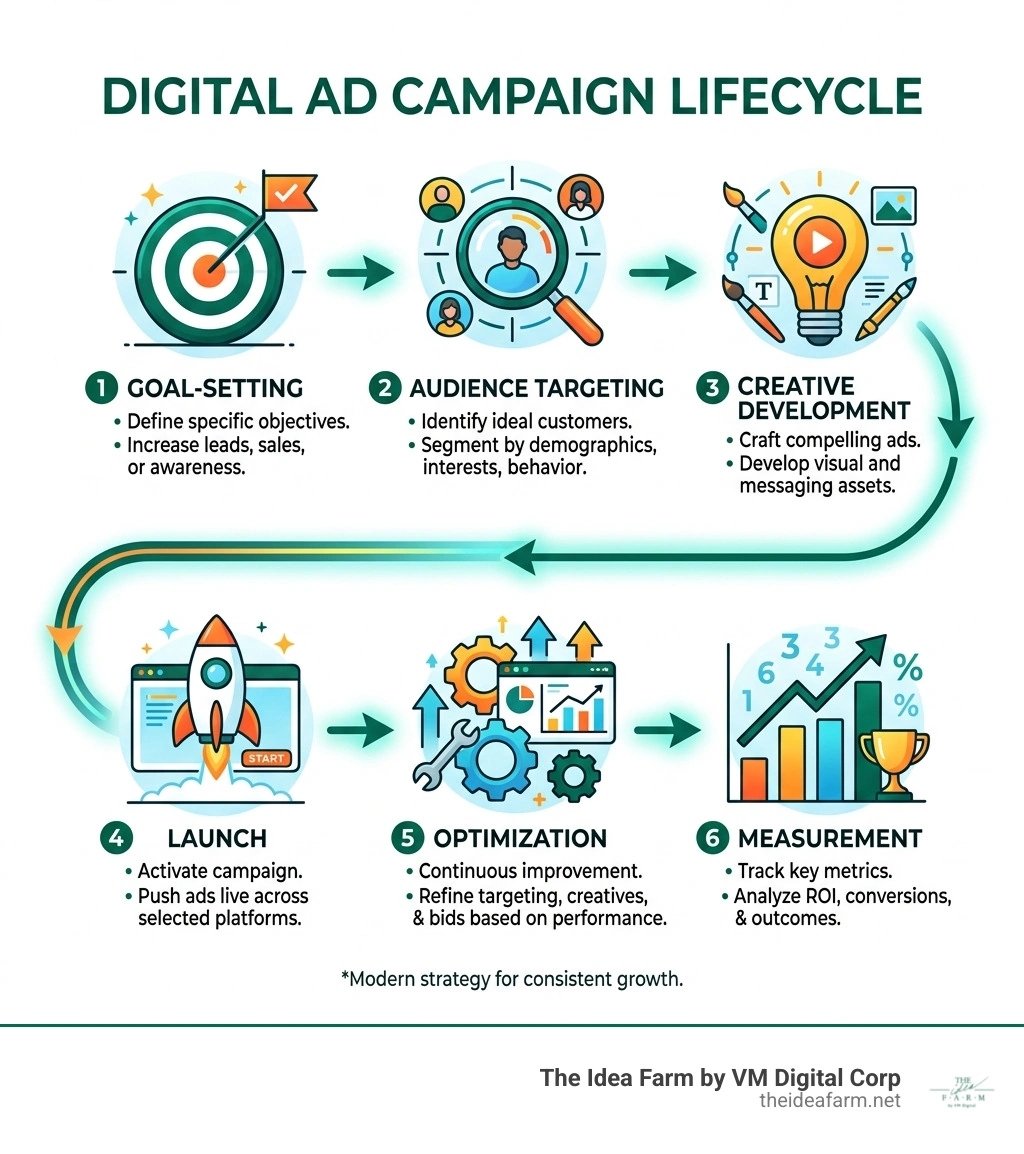
Every digital ad campaign needs SMART goals. This means they are Specific, Measurable, Achievable, Relevant, and Time-bound. Instead of saying "we want more sales," say "we want 50 new customers from LinkedIn by the end of next month."
You must know who you are talking to. We build buyer personas based on real data. We look at their age, their job, their problems, and where they spend time online. This helps us choose the right platforms. If you are looking for help with this in Texas, see our list of Advertising Agencies in Houston.
People do not usually buy the first time they see an ad. We map out the journey:
Do not get distracted by "vanity metrics" like likes or follows. Focus on:
Your budget should be based on your goals. We work backward from the revenue you want to reach. If you know it costs $100 to get a customer and you want 10 customers, your budget needs to be at least $1,000.
We also use testing frameworks. We might spend 80% of the budget on what we know works and 20% on testing new ideas. This keeps the digital ad campaign fresh and helps us find new ways to grow.
There is no single answer. However, many successful businesses spend between 5% and 15% of their total revenue on marketing. For a new digital ad campaign, start with a budget that allows for enough data to see what works. Usually, this means at least $2,000 to $5,000 per month depending on your industry.
Search ads can show results almost instantly. However, most campaigns need time to "learn." Platforms like Google and Meta use algorithms that take 4 to 6 weeks to fully optimize. Be patient and do not make big changes too early.
It depends on your audience. If you sell to other businesses (B2B), LinkedIn is often best. If you sell a visual product to young people, Instagram or TikTok is the way to go. If people are searching for your service by name or type, Google Search is a must.
A digital ad campaign is a powerful tool for growth. But it only works when it is part of a larger system. Random ads lead to random results. A strategic system leads to scalable growth.
At The Idea Farm, we act as a Fractional Growth Partner. We do not just give you a list of tactics. We build the connected, data-driven systems that your business needs to win. Whether you are in Houston or Danville, we focus on the numbers that matter to your bottom line.
If you are ready to stop guessing and start growing, we can help you build a system that works.