

June 15, 2026
The digital advertising services inquiry conducted by the Australian Competition and Consumer Commission (ACCC) is one of the most significant investigations into ad tech competition ever undertaken in Australia. Here is what it found at a glance:
Quick Summary: What You Need to Know
If you are a business owner spending money on digital ads, this inquiry affects you directly. It touches how your budget is used, how much of it actually reaches your audience, and whether the platforms serving your ads are working for you or against you.
Digital advertising in Australia has grown fast. Spend quadrupled from $1.7 billion in 2008 to $9.5 billion in 2020. But as the market grew, so did the concentration of power. A small number of players, particularly Google, came to control nearly every layer of the ad buying and selling process.
That concentration is exactly what this inquiry set out to examine.
I'm Jose Escalera, CEO of The Idea Farm by VM Digital, and my background building companies across media, sales, and marketing gives me a practical lens on how the digital advertising services inquiry affects real business decisions around ad spend and platform strategy. In this guide, I'll break down what the inquiry found, why it matters, and what it means for how you invest in digital advertising.
Know your digital advertising services inquiry terms:
When the ACCC launched the digital advertising services inquiry, it wasn't just a casual look under the hood. It was a deep, 18-month study into the plumbing of the internet. The goal was to understand how "display advertising" (the ads you see on websites and apps) actually gets bought and sold.

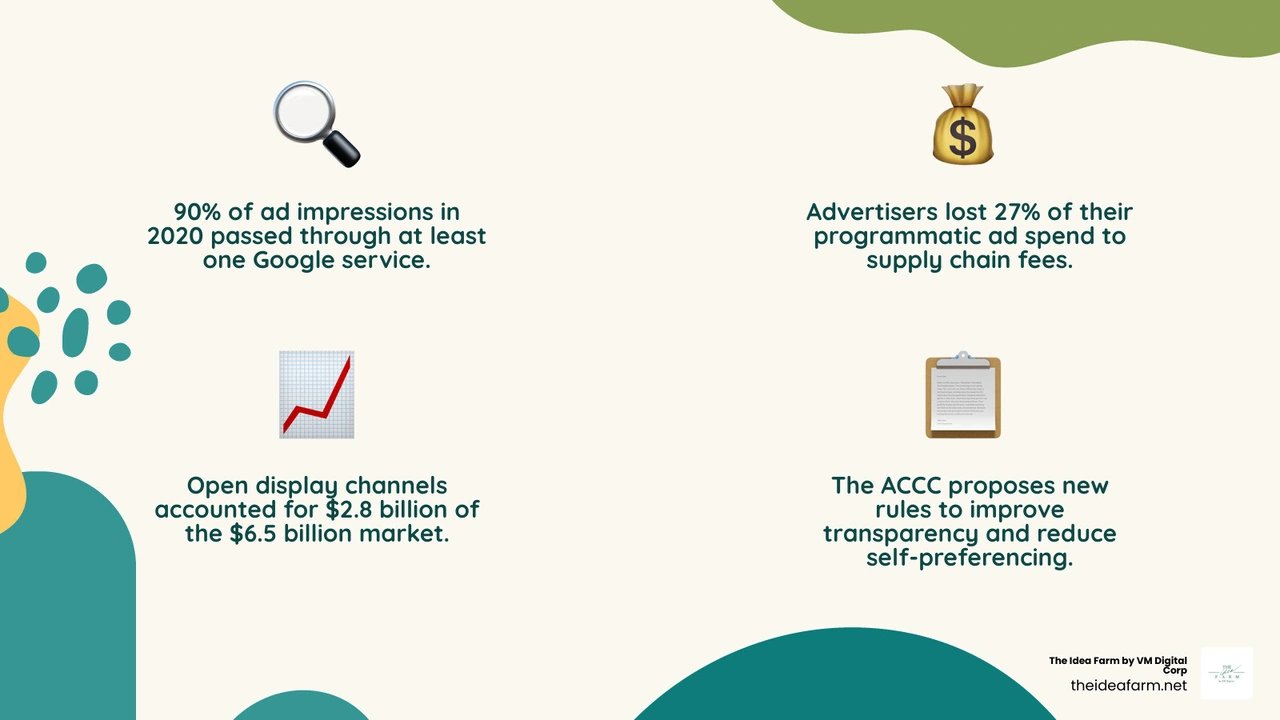
The Digital advertising services inquiry - final report - ACCC highlights that the inquiry focused heavily on "open display channels." These are the ads sold on the open web rather than inside "walled gardens" like Facebook. In 2020, this market was worth a staggering $2.8 billion in Australia. The ACCC wanted to know if this market was efficient or if middleman fees were eating up everyone's profits.
The biggest takeaway from the report is the sheer scale of Google's dominance. In 2020, over 90% of ad impressions in the Australian supply chain went through at least one Google service. Imagine if 90% of all food sold in a country had to pass through a single company's warehouse. That company would have a lot of power over prices and what people get to eat.
The ACCC found that Google’s share for each of the four main ad tech services was between 70% and 100%. This level of market power means that competition isn't just difficult; it's almost impossible for smaller players to survive without playing by Google's rules.
As a business owner, you care about this because it affects your bottom line. Digital ad spend in Australia hit $9.5 billion in 2020. If the system is rigged or inefficient, you are paying more for less.
When competition is healthy, ad tech providers have to lower their fees and improve their tools to keep your business. When one player dominates, those incentives disappear. We see this often when helping clients with their growth systems. If you don't understand the fees you're paying, you can't calculate your true return on investment. For more on how to navigate these waters, check out our Digital Advertising Experts Guide.
To understand the inquiry, you have to understand the "ad tech supply chain." This is the series of steps an ad takes from the advertiser's computer to the user's screen. It happens in milliseconds, but it involves many different players.

The chain starts with "Advertiser Ad Servers," which store the ads and track their performance. Then there are "Demand Side Platforms" (DSPs), which help advertisers buy ad space across many websites. On the other side, publishers (like news sites) use "Supply Side Platforms" (SSPs) and "Publisher Ad Servers" to manage and sell their ad space. For a deeper look at how this inventory is managed, see our Digital Advertising Inventory Management Guide.
Programmatic buying is just a fancy way of saying "automated ad buying." Instead of a person calling a website to buy an ad, computers use real-time bidding to buy space in the blink of an eye.
The DSP and SSP talk to each other to decide which ad wins the spot. The problem the ACCC identified is that Google often owns the DSP, the SSP, and the Publisher Ad Server. This vertical integration allows them to see what everyone else is bidding and potentially give themselves an advantage. This is a critical part of digital advertising campaign management that many businesses overlook.
Ad agencies sit at the front of this chain. They help businesses decide where to spend their money and which tools to use. However, the inquiry found that even agencies face transparency issues. Sometimes it's hard for an agency to tell a client exactly where every dollar went because the ad tech providers don't share all the data.
In our work as a Digital Marketing Agency Houston Guide provider, we emphasize transparency. If an agency isn't clear about their rebate arrangements or how they use certain platforms, the business owner loses out.
The ACCC's [PDF] Digital advertising services inquiry - Final report | ACCC is very clear about the issues caused by Google's vertical integration. Because Google is present at every stage of the supply chain, they can engage in "self-preferencing." This means they can design their systems to work better with their own products than with competitors' products.
For example, Google restricted the purchase of YouTube ad inventory so it could only be bought through its own DSPs. This forced advertisers who wanted to be on YouTube—which is almost everyone—to use Google's buying tools. This creates a "lock-in" effect where it's too much work or too expensive to use anything else.
When one company represents both the buyer and the seller, you have a classic conflict of interest. A buyer wants the lowest price, and a seller wants the highest price. If Google is running the auction and representing both sides, who are they really looking out for? Usually, the answer is Google.
This market distortion makes it hard for independent providers to compete. It also makes it difficult for publishers to get the best price for their ad space, which can hurt the quality of content available on the internet.
It is incredibly hard for a new company to enter the ad tech market in Australia. Google has a massive "data advantage" because they see what users are doing across search, maps, YouTube, and millions of third-party sites.
A new competitor doesn't have that data. They also don't have the same scale. Because Google's tools are already installed on 90% of publisher sites, a new provider has to convince those publishers to switch, which is a technical and financial headache. This technical lock-in keeps the market from being truly competitive.
One of the most shocking stats from the digital advertising services inquiry is the "take rate." In 2020, about 27% of what advertisers spent on programmatic ads went to fees for ad tech services. That means for every $100 you spend, only $73 is actually going toward showing an ad.
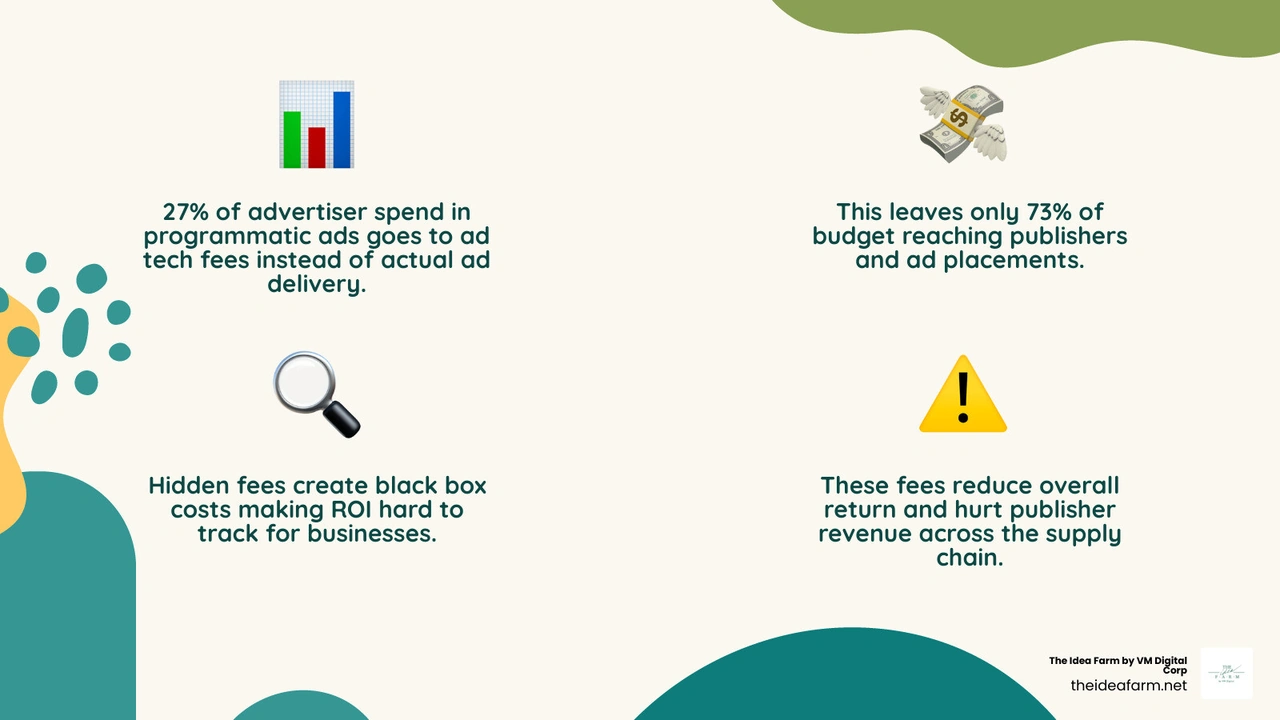
The ACCC Publishes Digital Advertising Services Report, Urges More ... news piece highlights that these fees are often hidden. Advertisers and publishers often don't know the full "black box" of costs between them. This lack of transparency makes it impossible to know if you're getting a fair deal.
High fees mean a lower ROI for you. If you're a small business in Houston or Danville, every dollar counts. If 27% of your budget is vanishing into the pockets of middlemen without providing clear value, your growth is being throttled.
For publishers, these fees mean they have less money to pay journalists or creators. This is why we focus so heavily on PPC Campaign Management that looks at the whole system, not just the clicks. You need to know where your money is going.
The ACCC recommended that the industry move toward independent verification. Right now, we often have to take the platforms' word for how well an ad performed. It's like a student grading their own homework.
Independent audits and better data access would allow businesses to see if they are actually reaching real people or just bots. This is a major part of Paid Search Houston strategy—verifying that the data matches the reality of your sales.
The ACCC isn't just pointing out problems; they are proposing solutions. They've asked for the power to create "sector-specific rules." These are rules that would only apply to companies with significant market power (like Google).
As noted in the article ACCC continues to investigate the Australian ad tech services ..., the commission wants to stop things like bundling (forcing you to buy one product to get another) and ensure non-discriminatory access to data.
The proposed rules would require dominant players to be more transparent about their auctions and fees. They would also prevent these companies from using their data advantage to give their own ad tech services an unfair head start.
If these rules are implemented, it would mean a more level playing field. For a business, this means more choices and hopefully lower fees over time. It’s about making the digital marketplace act more like a real market and less like a monopoly.
Australia isn't alone in this fight. The ACCC is looking at what the UK and the EU are doing with the Digital Markets Act. The goal is to have a consistent set of global rules. This is important because these digital platforms operate across borders. If the rules are the same everywhere, it’s harder for big tech companies to dodge them.
The ACCC wants to make digital ads fair. They want to stop one company from controlling everything. This helps small businesses compete because it ensures that ad spend is used efficiently and that the best tools win, not just the ones owned by the biggest company.
Google owns the tools that buyers use (DSPs) and the tools that sellers use (SSPs and Ad Servers). Because they are present at every step, they can see the whole market and favor their own services. They also use exclusive content like YouTube to force people into using their ad tech.
The ACCC wants new rules that prohibit self-preferencing and bundling. They want dominant providers to provide clearer information about their fees and auction processes. They also recommend giving the ACCC more power to monitor and enforce these rules to ensure the market stays competitive.
The digital advertising services inquiry is a wake-up call for the industry. It proves that the "black box" of ad tech has been working in favor of giant platforms for too long, often at the expense of the businesses paying the bills.
At The Idea Farm, we believe that growth shouldn't be a mystery. We act as a Fractional Growth Partner to help you build connected, data-driven marketing systems. We don't just look at clicks; we look at your numbers and goals to ensure your ad spend is actually driving scalable growth.
The findings of the ACCC inquiry reinforce why a strategic, transparent approach is so important. You need a system that works for your business, not one that just feeds a platform's bottom line. If you're ready to take control of your digital strategy and ensure your marketing spend is working as hard as you are, let's talk.