July 16, 2026
An ad campaign is a set of ads that work together. They have one main idea, message, or goal. They run on different channels for a set time. It is not just a single ad. It is a system.
Here is a quick list to answer your questions:
Most businesses waste money on ads because they do not plan. They post one time on social media. Or they run a quick Google ad and wonder why it fails. That is not a campaign. That is just noise.
To make a campaign work, you need a clear idea. You must show it to the right people in the right places over and over.
Think about it this way. You might remember a billboard from years ago. But you forgot the ad you saw five minutes ago. That does not happen by chance. It happens because of a smart campaign.
I am Jose Escalera, CEO of The Idea Farm by VM Digital. I help businesses stop using random tactics. I help them build real marketing systems that work. I have built companies in media, sales, and startups. In this guide, I will show you how to build, run, and measure campaigns that get results.
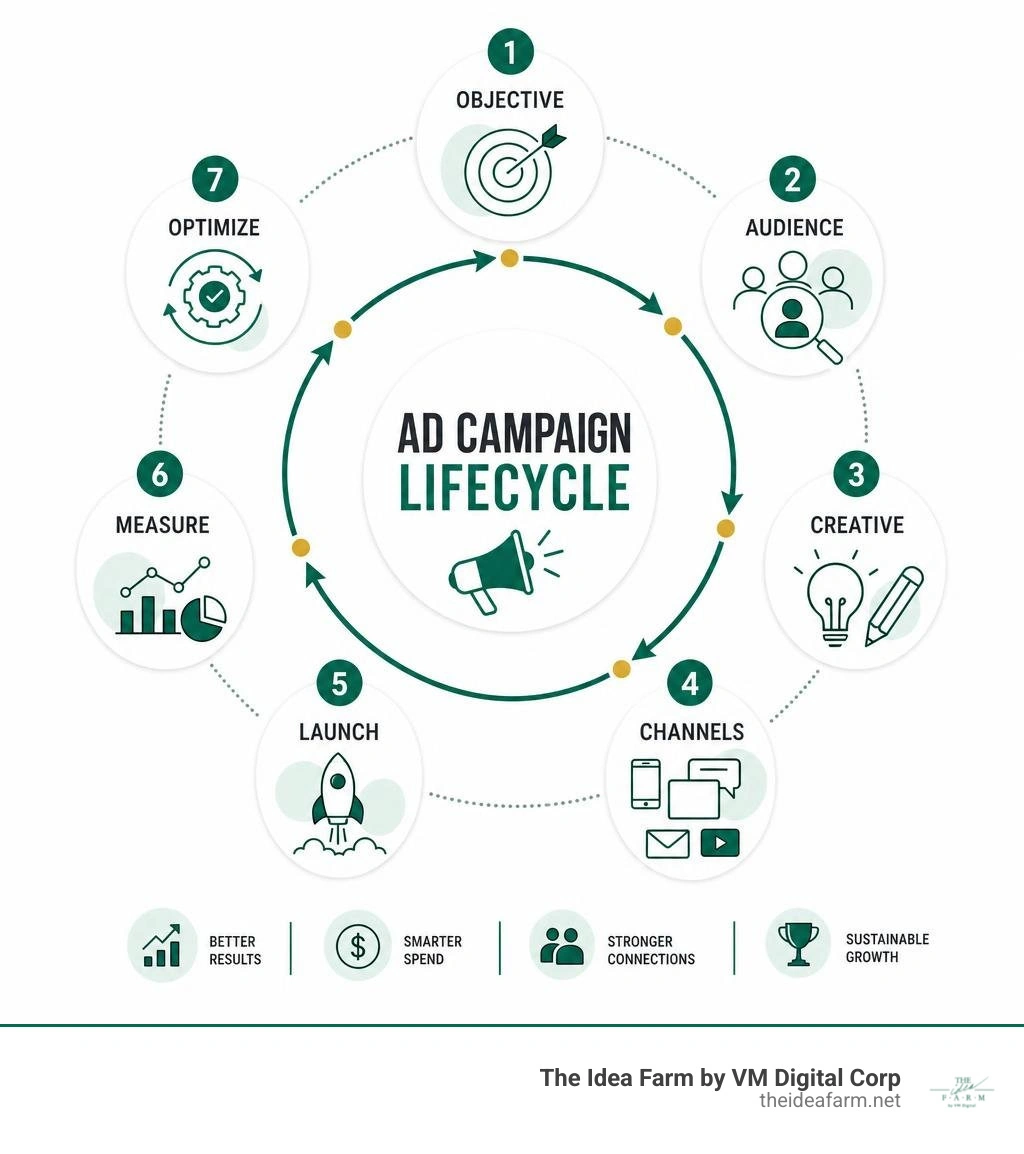

To build a great ad campaign, we must look at it as a whole system. Many business owners think an ad is just a pretty picture with text. But a good campaign uses Integrated Marketing Communications (IMC).
IMC means we make all our marketing messages match across every channel. A customer should get the same feeling from a billboard, an email, or a social media post. Research shows this boosts campaign results by 20% to 30%. This is because seeing the same message builds trust.
To make this work, we focus on four main pillars:
When we design a Digital Ad Campaign, we make ads that use different senses. Interactive ads are very good at helping people remember a brand. By mixing sights, sounds, and actions, we guide the customer from learning about us to buying from us.
Not all campaigns are the same. The type we choose depends on our goals, budget, and audience. We use three main types: digital ads, traditional media, and guerrilla marketing.
Digital ads are easy to target and measure. We can reach people based on what they search for or do online. Paid search ads target people who want to buy right now. Paid social ads help people get to know our brand. To learn how to set these up, read our Digital Advertising Services Complete Guide. If you need expert help, our Digital Advertising Experts Guide has more tips.
Traditional media includes print, radio, TV, and billboards. This is still great for local businesses. If your business is in Danville, Kentucky, billboards can build trust. You can check Danville, Kentucky Billboard Cost & Outdoor Advertising Rates or look to Rent High-Traffic Billboards in Danville, KY | Alluvit Media. Local ads work well. For example, a local poster won a big prize, as seen in Constitution Square poster wins national award, available for sale.
If you want to reach a big city like Houston, Texas, you can mix digital ads with TV. You can learn how to Advertise in Houston | TV + Streaming Local Advertising to reach families at home. Or you can connect your brand to city pride, like the New Promotional Campaign Welcomes the World to Houston.
Guerrilla marketing uses unusual, low-cost ideas to get big results. It is about using creativity instead of a huge budget. It works best when you want to make a fun buzz among your current customers.
Before we spend money on an ad campaign, we must know what we want to achieve. We set clear goals and describe our ideal customer.
We have three main goals for our ads:
Next, we map out our target audience. We do not just look at age or location. We write down their daily struggles and buying habits. This is very important for business-to-business (B2B) sales, where many people must agree on a purchase. We must give them the exact facts they need to share with their team.
If you want to reach people who are ready to buy, search ads are best. To learn how to set your bids and keywords, read our PPC Advertising Campaign Guide 2026.
Planning a successful ad campaign requires a step-by-step plan. If we make ads without planning our budget first, we will waste money.
The first step is setting the budget. We work backward from our goals. If we need 100 new customers, and it costs $50 to get one, we need a budget of $5,000. Then we decide how to split this money among different platforms.
Next, we choose our channels and make the ads. We must use the right format for each platform. Search ads use text to give quick answers. Social media ads need great pictures or videos. To make sure your ads look good, follow our Digital Ad Design Guide 2026.
After that, we set up our campaign. We group our ads, choose who will see them, and set our bids. To learn how to manage this daily, check out our PPC Campaign Management Guide 2026.
Budgets and targeting are the engine of a campaign, but storytelling is the fuel. Most people ignore ads. To get noticed, we must tell a real human story. The best ads do not just list product features. They connect with real feelings.
Look at how Spotify promoted its Premium plan. They did not talk about tech details or prices. They focused on a real human feeling. They made a campaign with close-up photos of goosebumps on human skin. You can read about how Spotify put goosebumps on a billboard and let your body do the rest. They used ice water and feathers to show real physical reactions. The message was simple: music moves you, and ads ruin that feeling.
Other brands use jokes to stand out. For their GOAT Sale, Flipkart used a viral video of a white buffalo. You can see how Flipkart rides viral buffalo fame with quirky ‘Bhains of Luck’ campaign for GOAT Sale - Storyboard18. They made the buffalo a funny mascot that helped people find discounts. It was silly and people loved to share it.
We also see this with safety and health ads. KFC worked with Johnny Knoxville for a July 4th safety campaign. They used his stunt-man fame to warn people about fireworks in a fun way. Novartis ran a Super Bowl ad called "Relax your tight end" with NFL players. It used sports humor to teach men that prostate cancer tests are simple blood tests, not scary exams.
A good marketing system does not rely on paid ads alone. We must balance three types of media:
When we run a paid ad campaign, we want to send people to our owned media. There, we can turn them into customers. If our paid ads are great, they can also get us earned media when people share them. Managing this balance is key to growth. To see how we do this, read our guide on Digital Advertising Campaign Management.
If we cannot measure our ad campaign, we cannot make it better. One big mistake is looking at the wrong numbers. Many business owners get excited about likes and views. These are nice, but they do not pay the bills. We must focus on numbers that show real business growth.
To keep your campaigns on track, use a good management system. To learn how to watch your campaigns and stop wasting money, read our guide on PPC Campaign Management.
To make smart choices, we must track these key numbers:
We also use attribution models to see the customer journey. Most people do not buy the first time they see an ad. They might see a video, search for us later, and then buy from an email. These models help us see which ads helped the most so we can spend our budget wisely.
Advertising is changing fast. In 2026, global digital ad spend will reach $667.65 billion. This growth is driven by AI, personal ads, and social media video.
AI helps us study data and change bids in real time. It lets us show different ads to different people based on what they like. But as AI makes more fake content, people want real experiences.
We saw this when Polaroid ran an outdoor campaign on Coney Island beach. You can read about how Polaroid drops another provocative reminder that the best of life is analog, this time on Coney Island beach | Polaroid Newsroom. They put a giant billboard in the sand that said: "Go jump in some water before the data centers drink it all up." It was a bold message telling people to put down their phones and use real film.
At the same time, social media video is huge. Video ads get ten times more engagement than static images. Brands also use big events to launch ads. During the World Cup, Polymarket launched its first big campaign using cinematic videos and flags. You can read about how Polymarket's Debut Brand Campaign Launches During World Cup // Rick Rubin, Future & Peso Pluma - Roastbrief US.
We hear many of the same questions from business owners. Here are quick, simple answers to help you.
A single ad is a one-time message, like one social media post. An ad campaign is a planned system. It uses a series of different ads with the same theme to guide a customer to buy over a few weeks or months.
We suggest letting a campaign run for 4 to 6 weeks before making big changes. Ad platforms use smart computers to find your best audience. If you change things too fast, you stop this learning process and hurt your results.
The average click-through rate (CTR) for display ads is 0.35%. These ads show up on other websites while people are reading. They are best for helping people learn about your brand, not for quick sales.
Running a great ad campaign is not about luck or huge budgets. It is about building a smart system that tells a real story and keeps a consistent message over time.
When you align your targeting, your creative ads, and your tracking, you stop wasting money. Instead, you build a reliable engine to grow your business.
At The Idea Farm, we do not sell basic packages. We act as your growth partner. We look at your numbers, your sales, and your goals to build custom systems that scale.
If you are ready to stop guessing and start growing with a clear plan, Get started with strategic growth consulting today. Let us build a system that works for your business.