
April 15, 2026
Many business owners spend money on ads that do not work. They see people visit their website and then leave. They do not know why. This happens because they focus on what they sell. They do not focus on how people buy.
That gap creates big problems. Sales blames marketing. Marketing blames the website. Support hears the same complaints. No one sees the whole path. When you only look at one part, you miss the real issue. Growth slows when the path is broken.
Customer journey mapping is drawing every step a customer takes with your brand. It starts when they first hear about you. It ends long after they buy.
Here is a quick list:
Salesforce says in their 2024 State of the Connected Customer report that 80% of people care about the experience as much as the product. PwC research shows that 65% of US consumers are more loyal to brands that give them a good experience.
These numbers matter. Growth is not just about more ads. Often, the problem is friction. A buyer cannot find the next step. A form is too long. An email is late. A new customer is confused. Each small break hurts your sales.
I am Jose Escalera, CEO of The Idea Farm. I help businesses build systems that grow. Customer journey mapping is a tool I use to help clients stop guessing. In this guide, I will show you how to build a map that grows your business.
A strong map helps you answer these questions:
When you know these things, you can grow faster. That is why customer journey mapping is a tool to make more money.
Customer journey mapping vocabulary:
Customer journey mapping helps you see your business through the eyes of the customer. Most people think buying is a straight line. They think a person sees an ad and then buys. But it is not that simple.
Most people use three or more ways to talk to a business. They might see a post on a phone and buy on a computer later. If these steps do not feel the same, you lose them. Many people switch brands because they are not happy.
When we map the journey, we look for friction. These are spots where a customer gets mad or bored. Maybe your site is slow. Maybe your price is hard to find. A map helps you see how one bad step hurts the next one.
Customers judge the whole experience. A good sales call cannot fix a bad website. If your steps are weak, you lose money.
This is why customer journey mapping is great for leaders. It gives one view of marketing, sales, and service. You can see the full path and what to fix first.
Fixing these spots helps you make more money. It turns a leaky bucket into a strong system.
Better growth does not come from doing more. It comes from fixing the path. That is what makes this process work. It connects the customer experience to your results.
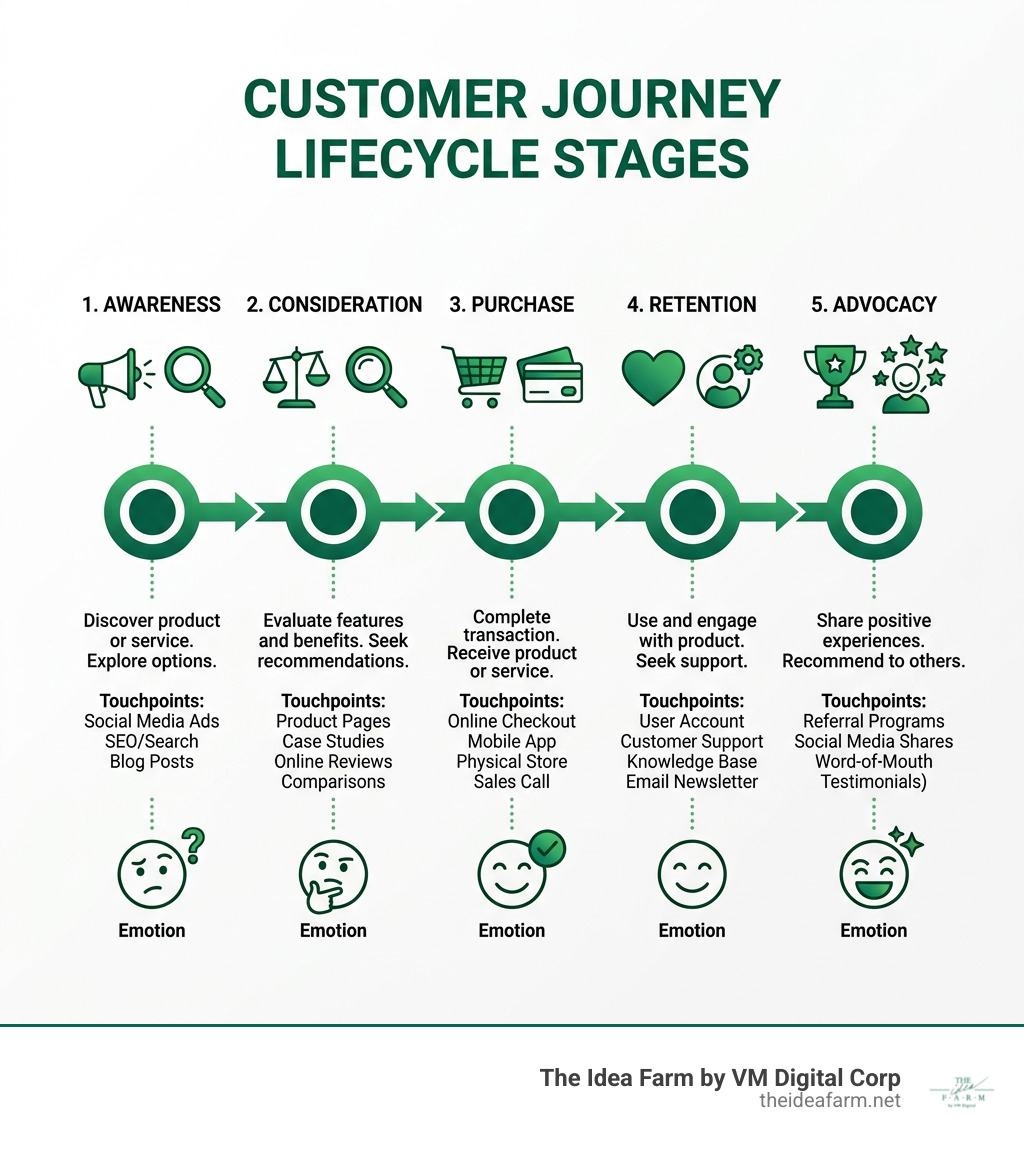
A good map is a plan. It links what customers do to how your business grows. To build a map that works, you need these five parts:
You must know who is on the journey. A persona is a profile of your ideal customer. It lists their goals and fears. A young person wants things fast. An older boss wants a partner they can trust.
A persona is more than a job title. It shows the problem the buyer wants to fix. It shows what they fear and what proof they need. This helps your team make better ads and sales steps.
These are all the places where a customer meets your brand. This includes your site, reviews, and calls.
Touchpoints also include the steps in between. A person may see an ad, read a review, and then get an email. If these steps feel different, trust goes down. Mapping helps you see where the story breaks.
Most maps only track what people do. Good maps track how people feel. Are they happy or worried? If you know they are worried, you can send an email to help them feel safe.
People do not buy with logic alone. A person may like your offer but still wait if they feel unsure. When you know their feelings, you can say the right thing at the right time.
Where do they get stuck? These are pain points. Where do they see that your product works? These are success milestones. You want to fix the pain and help them succeed fast.
Pain points show where you lose money. Success milestones show where trust grows. If you help them see value fast, they will stay with you longer.
What does your business do at each step? If they buy, do you say thank you? If they have a problem, do you help?
Your responses should be clear. If a customer stops, what do you do? If they ask for a price, what do you show them? Strong responses turn the map into a system that works.
We use two types of maps to help businesses grow:
| Feature | Current State Map | Future State Map |
|---|---|---|
| Purpose | Find what is broken now | Design the best path |
| Focus | Real data and complaints | New ideas |
| Goal | Fix problems | Plan for growth |
| Usage | Quick changes | Long-term plans |
Both maps matter. The current map shows what costs you money today. The future map helps you build a better system for tomorrow. First, fix the problems. Then, build a path that can scale.
Building a map is simple. We use real data to make sure the map is true. You can use the NN/g Template to start.
Why are you making this map? Do you want more sales? Do you want to keep customers longer? You must have a goal.
Be specific. A goal could be to get more calls or fewer people leaving at checkout. A map with no goal is just a picture. It does not help you make money.
Do not guess. Look at your website numbers. Talk to your customers. Ask your sales team what they hear.
The best data comes from:
When these sources say the same thing, you can trust it.
Create one to three personas. Give them names. Know why they want to buy from you.
Keep it simple. If you have too many, the map is hard to use. Start with the customers who bring in the most money.
List every time a customer talks to you. Start from the first time they see you until they are a fan. Be honest about what is broken.
Include web pages and human steps. Do not forget calls, emails, and bills. All these steps matter.
Draw a line to show if the customer is happy or sad. A low point is where you are losing money.
This helps your team see problems fast. A sad point often means a slow reply or a confusing step.
These are the most important steps. If you fail here, the customer leaves. If you do well, you win.
These moments include the first visit, the first call, and the checkout. These steps need the most work. Small wins here make a big difference.
Try to buy your own product. See if the map is right. Ask a few customers if the map looks like their experience.
This keeps the map honest. Your team might think the path is easy, but a customer might find it hard. Testing fixes that.
A map is never finished. When you fix a problem, update the map. Check it every six months. Markets change, and your map should too.
Use the map to make choices. Review it when sales drop or when you start something new. It should help you grow, not just sit on a shelf.
A funnel is about the brand. It is a straight line. It is about what we want the customer to do.
Customer journey mapping is about the customer. It is not a straight line. It shows that people might stop or need help after they buy. A funnel stops at the sale. A journey map helps you keep the customer for a long time.
To get the best results, follow these tips:
AI helps make customer journey mapping better. We use AI to:
At The Idea Farm, we do not like random marketing. We like systems. Customer journey mapping is the plan for those systems. It shows us what to build and how to grow.
If your growth has stopped, look at your journey. You do not need to work harder. You need a better plan.
We are a growth partner for businesses that want to scale. We help you build systems based on data. If you are ready to stop guessing and start building, we can help.
Learn more about our fractional CMO services and how we build growth systems.