
May 26, 2026
Digital marketing for B2B companies is the use of online channels, including search, email, content, social media, and paid ads, to reach and convert business buyers into paying customers.
Here is a quick breakdown of what it involves:
Here is the problem most B2B leaders run into.
You have a real product. A capable team. You are spending on marketing. But the pipeline is inconsistent. Some months are great. Others are quiet. And nobody can clearly explain why.
That is not a budget problem. It is a systems problem.
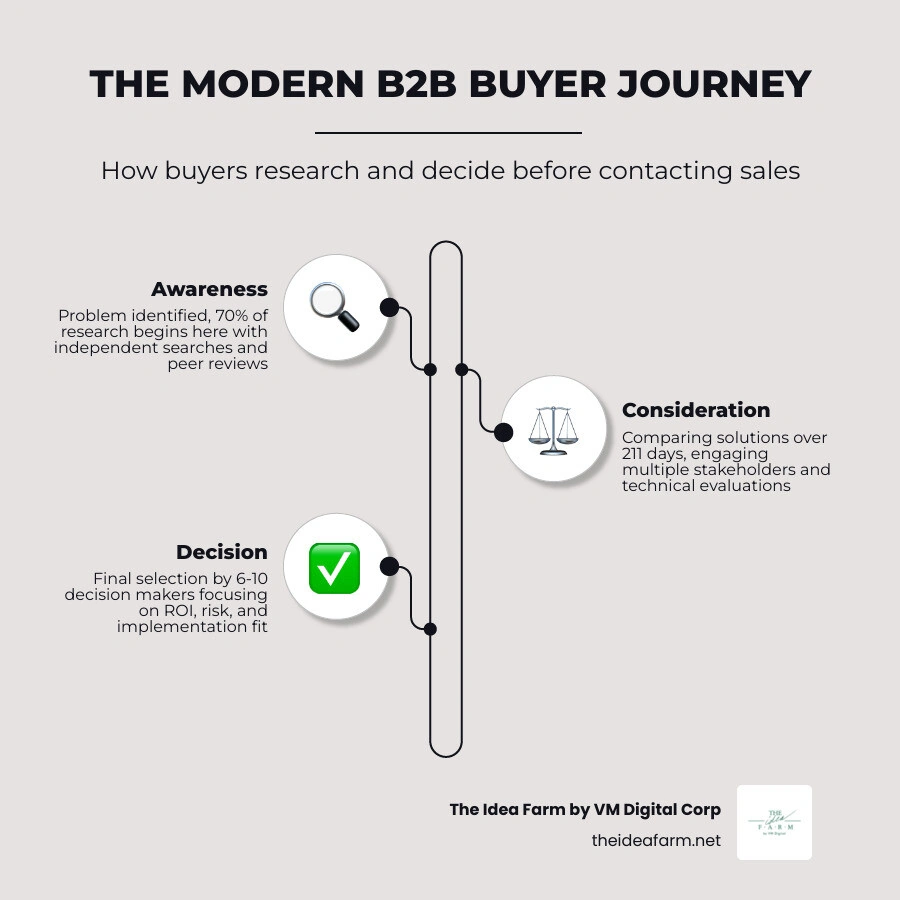
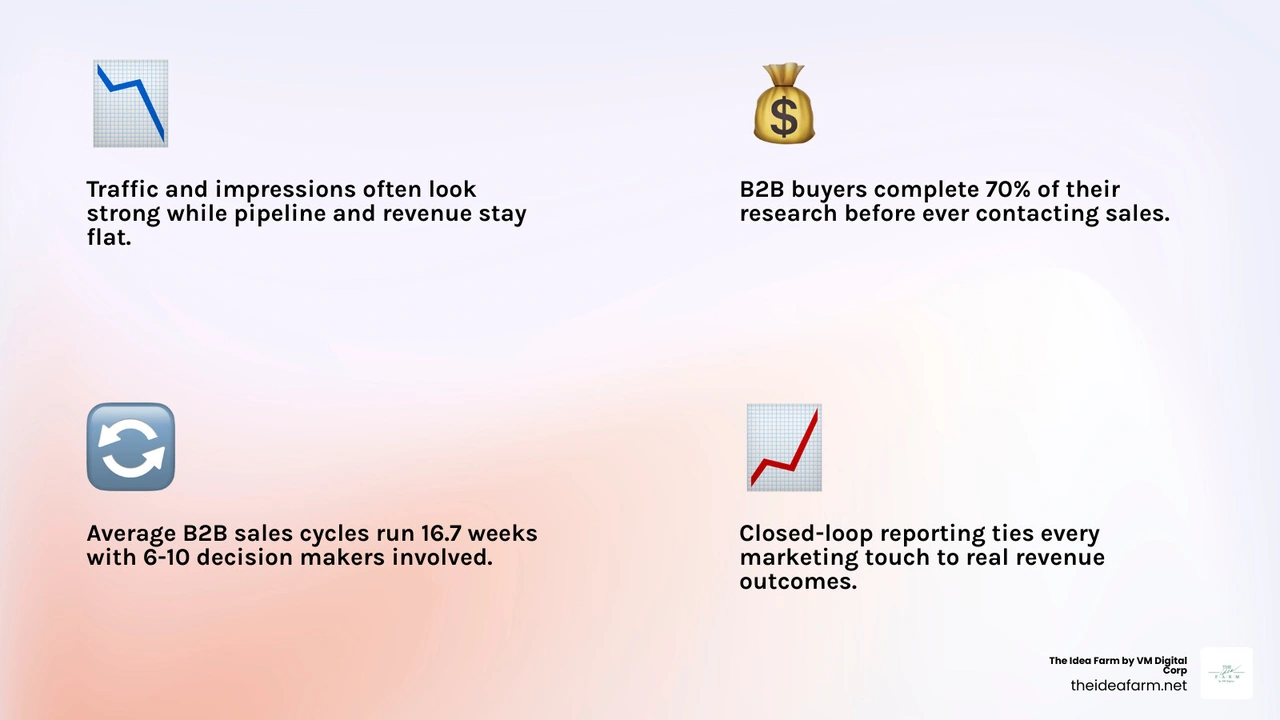
B2B buying is complex. The average sales cycle runs 211 days. Deals involve anywhere from 6 to 10 decision-makers. And today, up to 70% of the buyer's research happens before they ever talk to your sales team. If your digital presence is not built to meet buyers where they are, you are invisible during the moments that matter most.
This guide is written to help you fix that. Not with a list of disconnected tactics, but with a clear view of how the pieces connect into a system that drives real revenue.
I'm Jose Escalera, CEO of The Idea Farm by VM Digital, and I have spent my career building companies, advising growth-stage businesses, and applying sales psychology to digital marketing for B2B companies across multiple industries. That experience shapes every framework in this guide. Let's get into it.
At its core, B2B digital marketing means helping one business sell to another business through digital channels.
That sounds simple. It is not.
In B2B, buyers are not casually browsing during lunch and buying five minutes later. They are researching. Comparing vendors. Sharing links internally. Asking finance, IT, operations, and leadership for input. In many cases, the buyer wants to self-serve before speaking with sales.
That changes everything.
A strong B2B digital strategy has to do four things well:
B2C usually targets one person. B2B often targets a buying group.
B2C purchases are often faster, lower risk, and more emotional. B2B purchases are usually larger, slower, and tied to business outcomes. Research shows many B2B decisions involve 6 to 10 decision-makers and can take 16.7 weeks or longer just to move through selection.
That does not mean emotion disappears in B2B. People still want safety, confidence, and a good reputation inside their company. But the message usually has to pass the "show me the ROI" test.
So the big differences are:
In 2026, buyers are even more digital-first than they were a few years ago. More than 70% of B2B buyers are Millennials and Gen Z. These buyers are comfortable researching on their own, reading reviews, using social media, and asking AI tools for help.
This matters because search behavior is changing. Gartner predicts traditional search volume could drop by 25% by 2026 as AI tools answer more questions directly. That means your brand cannot rely on old SEO habits alone. You need traditional SEO, strong content, and what many now call generative engine optimization, or GEO.
In plain English: if buyers search with Google, LinkedIn, review platforms, and AI tools, you need visibility across all of them.
Most weak B2B campaigns have the same problem. They start with channels before strategy.
If you run ads before defining who you want, what they care about, and why your offer matters, you are paying to spread confusion faster. That is an expensive hobby.
Your ideal customer profile, or ICP, defines the type of company that is the best fit for your offer. Your buyer personas define the people inside those companies.
Start with firmographics:
Then define the people in the deal:
This is not optional. Up to 81% of B2B marketers use firmographic segmentation because it improves targeting and relevance. Companies with documented personas also tend to convert better and move deals faster.
For a deeper look at building better audience insight, see customer data driven marketing.
Good positioning answers one question quickly: why choose you instead of doing nothing or choosing someone else?
Your positioning should clarify:
Strong positioning is simple. It is not a paragraph full of words like "synergy" and "innovation" that mean everything and nothing. If your message needs a translator, it will not convert.
This is where many B2B companies get stuck. They describe features, not business outcomes. Buyers care more about lower cost, faster workflow, less risk, more revenue, or fewer headaches.
If your positioning needs work, start with strategic marketing consulting.
A B2B buyer journey is not one straight line. It is more like a group project where nobody read the same email.
Still, most journeys move through three stages:
Because the average B2B sales cycle is 211 days, your content and campaigns need to support each stage.
Awareness content might include:
Consideration content might include:
Decision content might include:
Also define the handoff points between marketing and sales. If marketing says a lead is "qualified" but sales says "who is this person," your funnel is leaking.

The best channels depend on your offer, market, sales cycle, and deal size. But a few channels consistently work well in B2B when the strategy is sound.
SEO is still one of the strongest long-term channels in B2B. Research shows 33% of B2B companies say SEO is their top lead generator.
Why it works:
The highest-value SEO content for B2B is usually not random blog fluff. It is intent-driven content tied to real buying questions:
You also need technical SEO. Slow pages, poor site structure, broken internal links, and weak metadata quietly kill performance. If your foundation is shaky, content alone will not save it.
For more on connected search strategy, see B2B Internet Marketing Company and How to nail B2B marketing in 2026.
Email remains a core B2B channel. About 93% of B2B marketers use it, and some research puts its ROI as high as $44 for every $1 spent.
But B2B email only works when it is useful.
Best practices:
A good nurture system keeps your company visible during long buying windows. It can educate, answer objections, surface proof, and help sales prioritize follow-up.
For related strategy, see B2B Marketing Growth.
B2B buyers use social media for research too. About 75% do so before making a purchase. And LinkedIn remains the top B2B social platform. Research shows 96% of B2B content marketers use LinkedIn, and many say it is one of their best organic traffic sources.
LinkedIn works well for:
One of the most underused B2B tactics is employee advocacy. Content shared by employees can earn more than eight times the engagement of regular brand content. People trust people more than logos. Shocking, we know.
A practical LinkedIn mix looks like this:

Paid media helps when you need speed, control, or targeted reach.
In B2B, the most effective paid programs usually focus on:
Google Ads is great for bottom-funnel demand capture. LinkedIn Ads is strong for precise audience targeting, especially by role, seniority, and company type.
Retargeting matters because most B2B buyers do not convert on the first visit. They research, leave, come back, ask a coworker, forget, return, and then finally fill out a form after seeing you for the fifth time.
For practical acquisition strategy, see customer acquisition strategy.
B2B content should not be dry. Clear does not mean dull.
In fact, 49% of B2B decision-makers say they are more likely to explore a company if its advertising is creative. That is a good reminder that serious buyers still appreciate strong ideas.
One of the biggest mistakes in digital marketing for B2B companies is writing for a single lead when the real audience is a committee.
Each stakeholder cares about different things:
This means one asset is rarely enough. Your marketing should create role-based paths and proof points. If you only speak to the champion, the deal can still die in procurement or security review.
Complexity is normal in B2B. Confusion is not.
Use simple language. Show clear outcomes. Answer the questions buyers are already asking. The best content often wins because it reduces risk and makes the next step feel safe.
High-converting B2B content types include:
A good rule: if your sales team explains the same thing every week, turn it into content.
Good B2B creative does three things:
That can mean strong design, a sharp headline, a clear chart, or a bold but relevant hook. Creative does not have to be flashy. It has to be useful and easy to remember.
Context matters too. A CFO seeing a LinkedIn ad may need a very different message than an operations manager landing on a comparison page from Google.
If you cannot connect marketing to pipeline, you do not have a growth engine. You have activity.
Too many teams obsess over traffic, impressions, and raw lead volume. Those metrics are not useless, but they are not the main score.
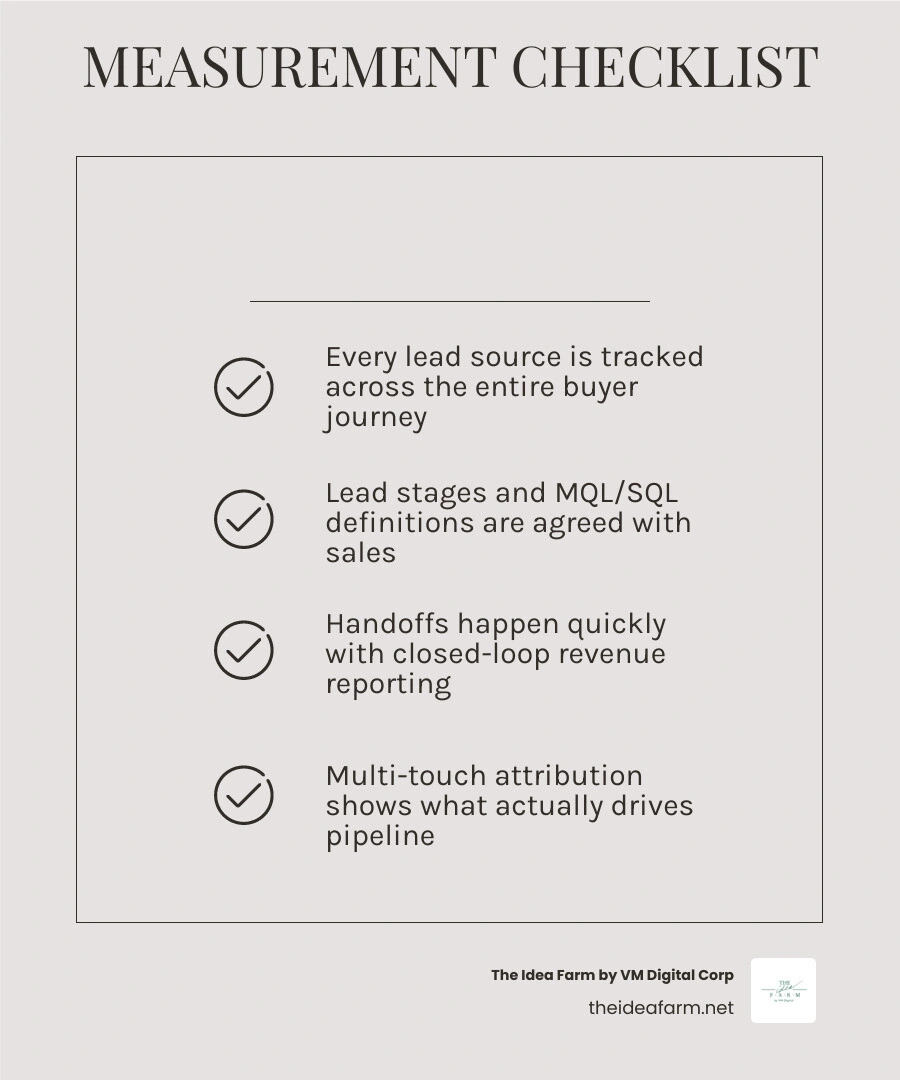
Start with these:
Conversion rate is especially important because it reflects both traffic quality and message quality.
Your CRM should be the source of truth.
That means:
This matters because B2B journeys are long and multi-touch. Last-click attribution alone is too simple. A buyer may first find you through search, return through retargeting, join a webinar, open three emails, and then book a demo from a direct visit.
For a better measurement framework, see measure marketing effectiveness.
The best B2B programs are not built once. They are improved over time.
Test things like:
Then reallocate budget based on performance, not opinions. A channel should earn more budget, not inherit it.
For more on ROI improvement, see improve marketing ROI and marketing performance optimization.
AI is not the strategy. But it is becoming part of the operating system.
By late 2025, a projected 95% of B2B organizations were expected to use AI, mostly for content creation and data analysis. In 2024, 85% of marketers reported AI-driven content strategies.
AI is most useful in repeatable, data-heavy tasks like:
Used well, AI improves speed and focus. Used poorly, it creates generic content faster. That is not progress.
GEO is about helping your brand appear in AI-generated answers and AI-assisted research.
To improve visibility, create content that is:
Also strengthen your presence beyond your own website. Buyers look at reviews, social posts, third-party mentions, and expert commentary. In 2026, your digital footprint is wider than your homepage.
For more strategic support here, see growth marketing consultant.
Common traps include:
The best teams balance efficiency with depth. They automate the repetitive work and keep humans focused on strategy, insight, and message quality.
Paid media can show early lead activity in 2 to 6 weeks. SEO and content usually take 6 to 12 months to build meaningful traffic, and often longer to show full pipeline impact. ABM may show engagement signals in a few months, but revenue may take much longer.
The long sales cycle matters here. Even good marketing may need time to work through a 3 to 18 month buying process.
Many B2B companies invest around 6% to 12% of revenue in marketing, with a large share going to digital. The right number depends on growth goals, market maturity, margins, and deal size.
Early-stage or aggressive growth companies often spend more. Mature companies may spend less but demand stronger efficiency.
You need both.
The 95-5 rule is useful here. Only about 5% of your market may be actively buying at any given time. The other 95% is out of market for now. Lead generation captures the 5%. Brand building influences the 95% so they remember and trust you later.
That means your strategy should combine:
If you only chase hand-raisers, growth stalls. If you only build awareness with no path to conversion, revenue stalls. Balance is the game.
The main lesson is simple: digital marketing for B2B companies works best when it is built as a connected system.
That system starts with clear audience definition, strong positioning, and a mapped buyer journey. It grows through the right mix of SEO, content, email, social, paid media, and automation. And it improves when you measure what drives pipeline, not just what looks busy on a dashboard.
That is how we approach growth at The Idea Farm. We build connected, data-driven marketing systems around real numbers and real goals so growth becomes more consistent and more scalable.
If you want to go deeper, explore our growth marketing agency complete guide or see our approach to Digital Ads.